By myhandsanitizershop October 9, 2026
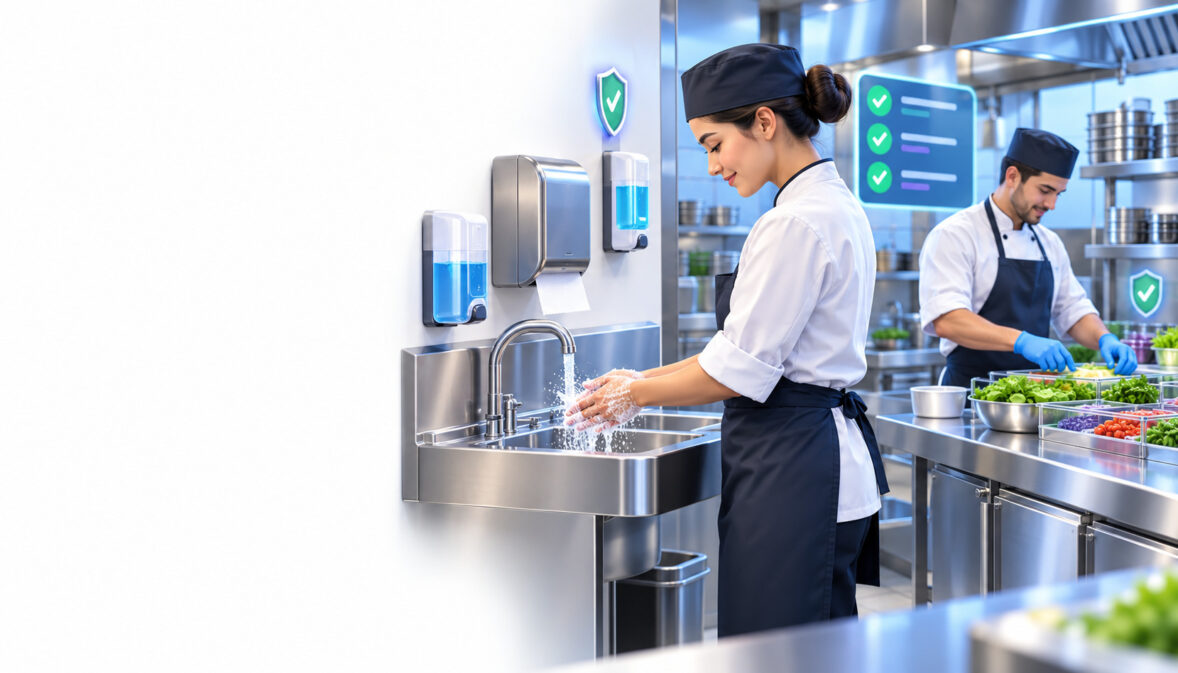
FDA Food Code hand sanitizer rules do not allow restaurant employees to replace required handwashing with sanitizer. Under the 2026 FDA Food Code, staff must wash their hands at designated sinks before food preparation and after contamination risks. Approved hand antiseptics may supplement proper washing, but sanitizer dispensers cannot replace accessible, properly supplied handwashing facilities.
A restaurant can have sanitizer dispensers at every entrance, a pump beside the prep counter, and a bottle at the cashier station—and still fail a health inspection because employees are not washing their hands correctly.
The distinction is simple but frequently misunderstood. Handwashing physically removes dirt, grease, and contamination. Hand antiseptics provide an additional antimicrobial step when used appropriately, but they do not perform the same cleaning function.
For restaurant owners, this affects kitchen layout, employee training, sanitizer purchasing, dispenser placement, and inspection readiness.
The FDA food code hand sanitizer rules also address which antiseptic products may be used in food establishments and what must happen if a product’s use could introduce residues into food.
This guide explains when handwashing is mandatory, where sanitizer stations belong, how gloves affect hand hygiene, what inspectors look for, and how to calculate sanitizer refills for a normal restaurant service week.
FDA Food Code Hand Sanitizer Rules: What Does the 2026 Code Actually Say?
The FDA released its 2026 Food Code on September 17, 2026, providing updated food safety guidance for restaurants, grocery stores, and other retail food establishments. The official FDA Food Code 2026 establishes model requirements for employee handwashing, hand antiseptics, glove use, and properly equipped handwashing facilities.
However, the Food Code is a model regulation rather than a single nationwide restaurant law. State, local, tribal, and territorial authorities determine which edition and amendments apply within their jurisdictions. Restaurant managers should therefore consult the 2026 FDA Food Code as the latest federal model while confirming the requirements enforced by their local health department.
FDA Food Code Sections Restaurant Managers Should Know
| FDA Food Code section | Subject | Restaurant requirement |
| § 2-301.12 | Cleaning Procedure | Proper handwashing for at least 20 seconds |
| § 2-301.14 | When to Wash | Required washing before food prep and after contamination triggers |
| § 2-301.15 | Where to Wash | Use approved handwashing facilities |
| § 2-301.16 | Hand Antiseptics | Appropriate products and food-contact safeguards |
| § 3-304.15 | Gloves | Proper glove use and limited approved double-gloving exception |
| § 5-204.11 | Sink Location | Conveniently located handwashing facilities |
| § 5-205.11 | Sink Accessibility | Unobstructed sinks reserved for handwashing |
| §§ 6-301.11–6-301.12 | Handwashing Supplies | Suitable cleanser and hand-drying provisions |
Source: FDA Food Code 2026, Chapters 2, 3, 5 and 6.
These rules work together.
A restaurant cannot satisfy the hand hygiene requirements simply by selecting a high-alcohol sanitizer. It needs correctly located washing facilities, the necessary supplies, employees who follow the required procedure, and suitable antiseptic products if sanitizers are used.
Can Restaurant Staff Use Hand Sanitizer Instead of Washing?
No. Hand sanitizer cannot replace a handwash required under the FDA Food Code.
A food employee returning from the restroom must wash their hands. So must someone switching from raw food handling to ready-to-eat food preparation.
Applying sanitizer without washing does not fulfill those duties.
The Food Code allows appropriate hand antiseptics as an additional measure, but their use must be consistent with the product requirements and food-contact protections.
For everyday training, the most useful instruction is:
Wash when required. Dry properly. Use an appropriate hand antiseptic afterward only when the restaurant’s approved procedure calls for it.
This prevents employees from treating sanitizer as a shortcut when the kitchen gets busy.
Restaurant Employee Handwashing Requirements: When Washing Is Mandatory
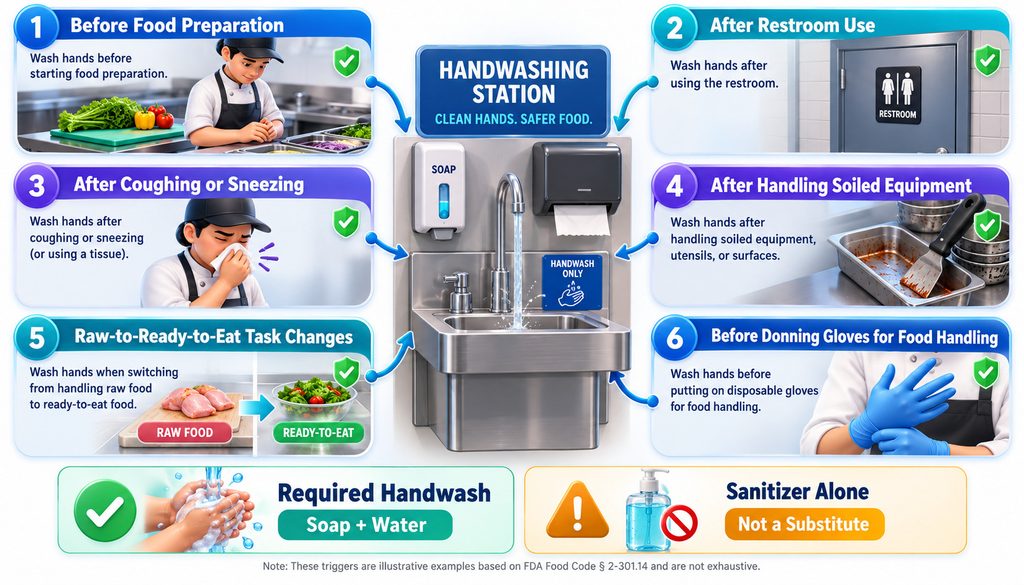
FDA Food Code § 2-301.14, When to Wash, identifies when restaurant food employees must wash their hands. Handwashing is required immediately before food preparation, including work involving exposed food, clean equipment, utensils, and unwrapped single-service items.
Employees must also wash after using the restroom, handling soiled equipment, coughing or sneezing, and engaging in other activities that contaminate their hands. During food preparation, washing is required as often as necessary to prevent cross-contamination when changing tasks, including when switching between raw and ready-to-eat foods.
The section also requires handwashing before putting on gloves to begin a task involving food. Applying sanitizer cannot replace any of these required handwashing steps.
When Employees Must Wash Their Hands
| Situation | Handwashing required? | Can sanitizer replace it? |
| Before beginning food preparation | Yes | No |
| After using the restroom | Yes | No |
| After coughing, sneezing, or using a tissue | Yes | No |
| After handling soiled equipment or utensils | Yes | No |
| When switching from raw food to ready-to-eat food | Yes | No |
| Before donning gloves to begin a food-handling task | Yes | No |
| During food preparation when needed to prevent cross-contamination | Yes | No |
| After other activities that contaminate hands | Yes | No |
| During an ordinary non-food-contact interaction with clean hands | Depends on the task and circumstances | Not a replacement for any required wash |
The regulation also covers contact with certain body parts, eating, drinking, tobacco use, and other contamination-related activities.
These are not optional best practices. They form part of the employee hand hygiene controls food establishments must follow where the relevant Food Code provisions have been adopted.
Example: Raw Chicken to Salad Preparation
Imagine a cook preparing raw chicken for grilling.
After finishing that task, the cook must move to an area where ready-to-eat salads are assembled.
Using sanitizer and putting on fresh gloves is not enough.
The correct process includes leaving the contaminated task, washing and drying hands appropriately, and then using suitable clean gloves or utensils as required for the next activity.
Any supplementary antiseptic step belongs after handwashing, not in its place.
Example: Cashier Helping With Food Preparation
A cashier handles payment terminals, cash, receipts, and customer transactions.
The employee is then asked to prepare an uncovered sandwich.
Even though the cashier’s hands appear clean, switching into exposed-food preparation creates a handwashing obligation.
A sanitizer dispenser beside the register may be useful for routine hand hygiene, but it does not eliminate the need to visit an approved handwashing sink before preparing food.
This is especially relevant in small restaurants where employees rotate between serving, handling money, cleaning, and preparing food.
How Long Must Restaurant Employees Wash Their Hands?
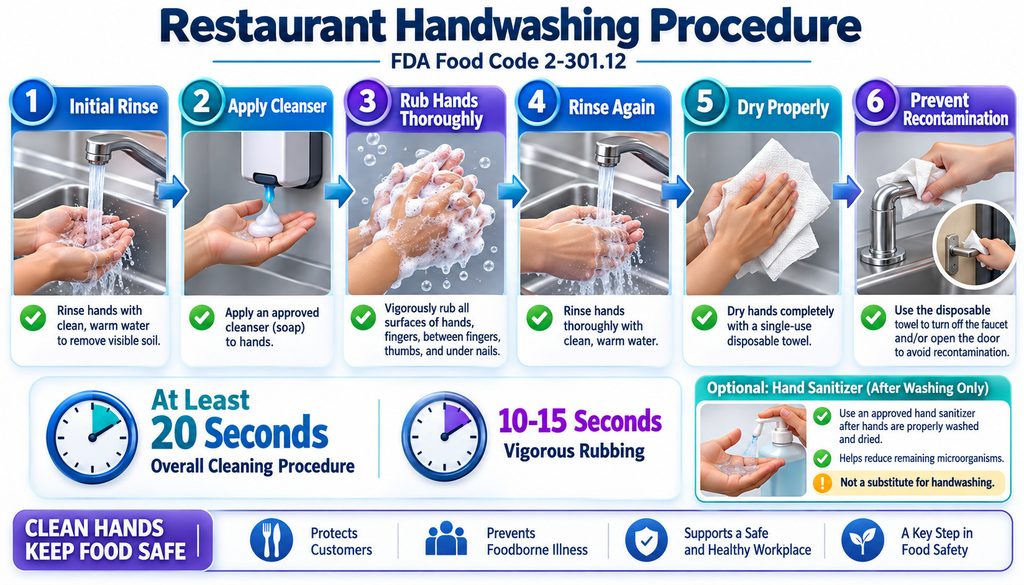
Under FDA Food Code § 2-301.12, Cleaning Procedure, food employees must clean their hands and exposed portions of their arms for at least 20 seconds using an appropriate cleaning compound at a properly equipped handwashing sink.
The required procedure involves rinsing under clean, running warm water; applying the manufacturer’s recommended amount of cleaning compound; rubbing vigorously for at least 10–15 seconds; rinsing thoroughly; and immediately drying using an approved method. Employees must pay particular attention to fingernails, fingertips, and spaces between fingers.
The 10–15-second vigorous rubbing interval is part of the overall procedure, not a replacement for the minimum 20-second handwashing requirement. The Code specifies rubbing the hands together vigorously for at least 10–15 seconds within the overall procedure.
Managers should not confuse that friction interval with the entire required washing duration.
The Correct Restaurant Handwashing Sequence
- Wet hands and exposed portions of the arms under clean, running warm water.
- Apply an appropriate cleaning compound.
- Rub the hands and exposed arms vigorously for the required interval, paying attention to fingertips, between fingers, and appropriate areas around fingernails.
- Thoroughly rinse with clean, running warm water.
- Dry using an approved method.
- Avoid recontaminating clean hands when operating faucets or opening doors.
- Apply an appropriate hand antiseptic afterward only if required by the restaurant’s approved process.
An employee should not use a sanitizer pump to skip the rinsing or drying stages.
Likewise, a sink with soap but no practical drying method is not a complete handwashing setup.
Why Wet or Dirty Hands Matter
Food preparation leaves grease, proteins, seasoning, and other residues on employees’ hands.
A sanitizer may provide antimicrobial activity when used appropriately, but it is not a substitute for physically removing these materials.
That is especially important after tasks involving raw animal foods, dirty utensils, restroom use, or food waste.
For an overview of the ingredients found in sanitizer products, comparing hand sanitizer ingredients explains how alcohol-based formulas differ from alternative antiseptic products.
In a restaurant, however, product selection must also satisfy the relevant Food Code provisions—not merely general consumer expectations.
Approved Hand Sanitizer Specifications for Food Service
A common purchasing mistake is assuming that any sanitizer labeled “kills 99.9% of germs” is automatically suitable for restaurant employees.
Section 2-301.16 takes a more specific approach.
It addresses topical hand antiseptics, antiseptic hand dips, and antiseptic soaps. Products must satisfy the applicable drug-related criteria and restrictions on their components and use in relation to food.
Is 60% Alcohol Enough for Restaurant Use?
For general consumer hand hygiene, products containing at least 60% alcohol are commonly recommended when soap and water are unavailable.
But the FDA Food Code does not establish a universal rule that any hand sanitizer containing 60% alcohol is automatically compliant for every restaurant task.
A restaurant should verify the actual product, its active ingredients, lawful marketing status, usage directions, and relevant food-contact considerations.
In particular, a sanitizer suitable for customer use at a host stand is not automatically appropriate for a workflow involving bare-hand contact with exposed food.
What Section 2-301.16 Requires
FDA Food Code § 2-301.16, Hand Antiseptics, sets specific requirements for topical hand antiseptics, antiseptic hand dips, and antiseptic soaps used in food establishments. The section addresses qualifying drug status, active antimicrobial ingredients, and product components that may affect food safety.
Under § 2-301.16(A)(3), covered hand antiseptics must be applied only to hands already cleaned according to the handwashing procedure in § 2-301.12. This confirms that sanitizer supplements proper washing rather than replacing it.
The section also establishes food-contact safeguards. Under § 2-301.16(B), when a topical hand antiseptic or antiseptic hand dip does not meet the component criteria in subsection (A)(2), its use must be followed by thorough hand rinsing in clean water before food contact or glove use, or be limited to situations involving no direct bare-hand contact with food.
Restaurant managers should verify a product’s intended use, ingredient information, directions, and applicable food-contact restrictions before including it in employee hygiene procedures. An alcohol concentration or marketing claim alone does not establish compliance with every FDA Food Code condition.
Do not assume that a product is compliant merely because:
- It is available from a restaurant supply company.
- It has a high alcohol concentration.
- It carries an NDC number.
- Its label says “professional.”
- It is described as “food safe” in advertising.
None of those statements independently establishes compliance with every applicable Food Code condition.
Restaurant Sanitizer Purchasing Checklist
Before installing a dispenser for employee use, confirm:
| Product characteristic | What to check |
| Intended use | Hand antiseptic for the intended setting |
| Active ingredients | Identified and suitable for applicable requirements |
| Drug status | Lawfully marketed product, as applicable |
| Directions | Appropriate application and drying instructions |
| Food-contact conditions | Whether extra restrictions or rinsing requirements apply |
| Ingredients | Compatibility with Food Code component provisions |
| Packaging | Suitable for the dispenser and location |
| Safety documentation | Available from the manufacturer or supplier |
| Expiration date | Within the manufacturer’s supported shelf life |
| Storage | Consistent with label and fire-safety requirements |
The most defensible purchasing approach is to retain the product information and obtain written manufacturer clarification when its suitability for food-handling tasks is uncertain.
For a closer look at formulation details, the article on active ingredients in hand sanitizers provides useful background on common antiseptic substances and their characteristics.
Hand Sanitizer vs. Food-Contact Surface Sanitizer
These two products must never be confused.
Hand antiseptic is formulated and labeled for appropriate application to human hands.
Food-contact surface sanitizer is intended for approved treatment of equipment, utensils, or food-contact surfaces according to its labeling and applicable requirements.
A chemical used to sanitize cutting boards or countertops is not automatically safe to apply to the skin.
Likewise, an employee hand sanitizer is not a substitute for proper warewashing or food-contact surface sanitization.
Keep supplies clearly identified and stored in their appropriate locations.
Food Code Hand Hygiene Stations: Where Should Restaurant Sinks and Sanitizer Dispensers Go?
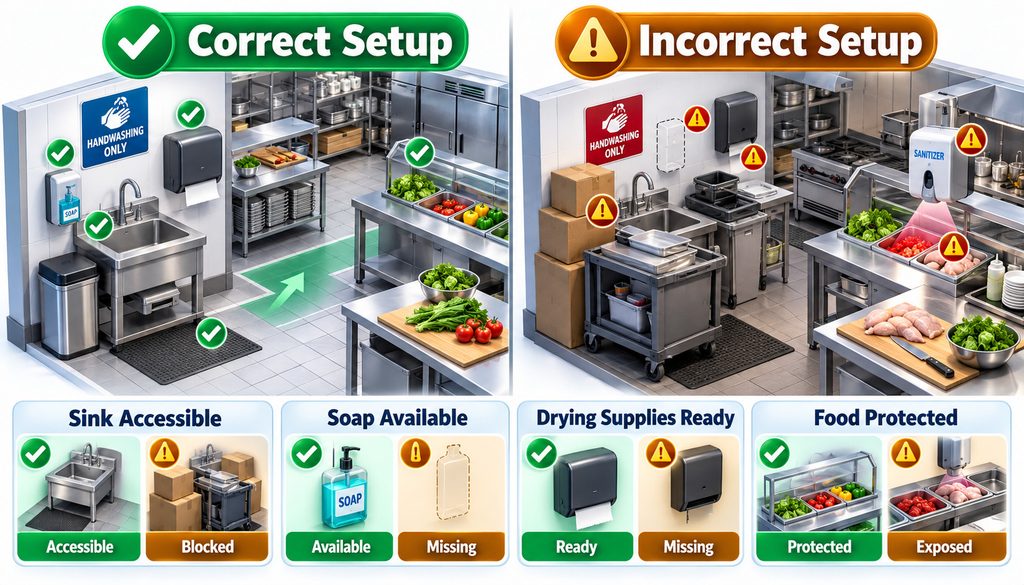
The best restaurant hand hygiene layout separates mandatory washing facilities from optional sanitizer locations.
A handwashing sink is part of the food safety infrastructure. A sanitizer dispenser is an additional hygiene resource.
Both can be useful, but they should not be treated as interchangeable equipment.
Where Handwashing Sinks Are Required
The FDA Food Code separates handwashing sink location, proper use, and accessibility into different requirements.
Under § 5-204.11, Handwashing Sinks, handwashing facilities must be conveniently located for employees working in food preparation, food dispensing, and warewashing areas. The Code also requires a handwashing sink in or immediately adjacent to toilet rooms.
Section 2-301.15 specifies that food employees must wash their hands at a designated handwashing sink or an approved automatic handwashing facility. Food preparation sinks, warewashing sinks, service sinks, and mop-water disposal facilities cannot substitute for these designated facilities.
Section 5-205.11 addresses ongoing operation and accessibility. Handwashing sinks must remain accessible and cannot be used for unrelated purposes such as storing utensils, collecting dirty dishes, or holding cleaning containers.
A sanitizer dispenser beside a blocked or improperly located sink does not correct the underlying handwashing compliance problem. Restaurant managers must ensure that employees can reach and use the appropriate washing facilities whenever required.
Recommended Sanitizer Placement by Restaurant Area
Sanitizer stations should be positioned according to customer movement, employee tasks, and the risk of contaminating food or nearby surfaces.
| Restaurant location | Sanitizer placement | Important consideration |
| Customer entrance | Recommended convenience location | Does not replace restroom or kitchen sinks |
| Host stand | Useful for front-of-house hygiene | Keep dispensers away from exposed food |
| Cashier or payment counter | Convenient supplementary station | Employees entering food prep must still wash |
| Service line | Possible where suitable | Prevent drips or contamination of food and utensils |
| Kitchen preparation area | Only as an appropriate supplementary station | Requires compliant handwashing facilities |
| Employee entrance | Helpful supplementary location | Staff must wash when Food Code conditions require |
| Restrooms | Optional alongside required handwashing facilities | Never substitutes for soap and water |
| Break room | Useful for non-food-preparation activities | Do not confuse with food-preparation hygiene |
A location described as recommended is an operational suggestion, not necessarily a specific FDA dispenser requirement.
Keep Sanitizer Away From Exposed Food
A dispenser positioned directly above uncovered ingredients can create unnecessary contamination risks.
Pump bottles may leak, employees may spill liquid, and spray products can disperse droplets beyond the intended application area.
Install dispensers where accidental discharge is unlikely to reach food, utensils, or food-contact surfaces.
Wall-mounted dispensers should be secure and accessible without obstructing kitchen movement.
The choice between gel and spray formats also affects placement. The differences in dispensing and coverage discussed in gel vs. spray hand sanitizers can help managers evaluate convenience, although Food Code suitability must be checked separately.
Alcohol-Based Sanitizer and Fire Safety
Commercial kitchens contain ignition hazards such as burners, hot equipment, and electrical appliances.
Alcohol-based sanitizer should not be installed or stored carelessly near these hazards.
The restaurant’s fire-safety requirements, product labeling, safety data, and local fire authority’s guidance should inform dispenser locations and bulk storage arrangements.
For businesses keeping multiple replacement containers on-site, the principles of storing bulk hand sanitizers are relevant to stockroom planning and inventory safety.
Keep replacement containers sealed and avoid placing supplies near open flames or intense heat.
What Health Inspectors Check: Common Hand Hygiene Violations
Health inspectors generally examine the actual handwashing environment and employees’ observed behavior.
Having a written policy does not compensate for a sink that employees cannot use.
Likewise, a fully stocked sanitizer dispenser does not correct an employee’s failure to wash after handling raw food.
Seven Common Hand Hygiene Problems
| Inspection concern | Example | Appropriate correction |
| Blocked handwashing sink | Food containers stored inside sink | Remove obstruction immediately |
| Missing soap | Empty soap dispenser | Refill and establish supply checks |
| No suitable drying supplies | Empty paper towel dispenser | Restore required drying method |
| Incorrect sink usage | Washing utensils in hand sink | Reserve sink for handwashing |
| Employees not washing | Cook changes tasks without washing | Retrain and correct behavior |
| Gloves used incorrectly | Gloves worn across contaminated tasks | Remove, wash when required, and replace |
| Inadequate facilities | Washing sink inaccessible during service | Correct layout or operational blockage |
These are examples of conditions inspectors may identify, rather than a claim that every violation carries the same classification or penalty.
The applicable local inspection form determines how findings are recorded and enforced.
Blocked Sinks Are More Serious Than They Appear
A restaurant employee may place a cutting board, cleaning container, or stack of dishes inside a handwashing sink because the kitchen lacks counter space.
That apparently minor convenience prevents other employees from washing when required.
Under the model Food Code, a handwashing sink must remain available for employee use and cannot serve an unrelated purpose.
The corrective action is not to put a bottle of sanitizer next to the blocked sink.
The sink must be made accessible again, and management should address the storage problem that caused the obstruction.
What About Missing Soap or Towels?
A working faucet is not enough.
The sink also needs the appropriate cleaning and drying supplies required by the applicable code.
For example, a kitchen may have a functioning handwashing sink but routinely run out of disposable towels during the dinner rush.
This can undermine hand hygiene even if employees understand when they should wash.
Managers should inspect handwashing facilities before service and assign an employee to replenish supplies as needed.
What Inspectors Observe During Service
Inspectors may watch employees moving between tasks, handling raw ingredients, changing gloves, using restrooms, or touching contaminated surfaces.
An employee who washes properly during the opening inspection but skips washing when changing tasks has not maintained the required practice.
The strongest inspection preparation is therefore an operating routine employees can follow consistently during busy service—not a temporary cleanup conducted when an inspector arrives.
How to Correct and Document a Violation
When a problem is discovered, correct it promptly and determine why it happened.
For example, an empty soap dispenser may indicate insufficient stock, an unassigned replenishment duty, or equipment failure.
A useful corrective-action record identifies the problem, immediate fix, responsible employee, and preventive measure.
Inspectors and managers should be able to distinguish a one-time correction from a recurring operational weakness.
Gloves Do Not Replace Restaurant Employee Handwashing
Disposable gloves can reduce certain direct-contact risks when used properly.
But gloves are not a substitute for washing hands.
Section 2-301.14 requires handwashing before donning gloves to begin a task involving food. The Food Code also addresses avoiding bare-hand contact with exposed ready-to-eat food, subject to defined exceptions and approved procedures.
A fresh glove placed on an unwashed hand does not eliminate contamination risks.
Example: The Sandwich Station
A worker puts on gloves and assembles several sandwiches.
The worker then uses a phone, handles a cleaning cloth, and returns to food preparation while wearing the same gloves.
The gloves are now a contamination concern, even if they remain intact.
The employee must follow the appropriate glove removal, handwashing, and replacement procedure before returning to food preparation.
A sanitizer application over the existing gloves is not an acceptable shortcut for routine single-use glove hygiene.
What Changed in the 2026 Food Code for Double-Gloving?
The 2026 FDA Food Code introduced a limited exception under § 3-304.15, Gloves, Use Limitation, allowing an approved double-gloving procedure under specific conditions.
The exception permits continued use of an interior single-use glove when it remains intact and uncontaminated after removal of a task-specific, loose-fitting exterior glove. The exterior glove must be removable without contaminating the employee’s hands or interior glove, and the procedure must satisfy all specified conditions.
This exception does not authorize employees to routinely reuse contaminated gloves or substitute glove changes for required handwashing. Restaurants should obtain appropriate regulatory approval before implementing a double-gloving procedure.
Training Restaurant Employees on the Wash-Then-Sanitize Sequence
Training works best when staff understand the reason for each step.
Employees should know that washing, drying, antiseptic application, and glove use have distinct purposes.
A simple poster can help, but practical demonstrations are more valuable than memorizing a slogan.
A Five-Step Employee Training Routine
- Recognize the trigger: Identify the activity requiring handwashing, such as returning from a restroom or switching from raw food to ready-to-eat food.
- Go to the designated facility: Use an approved handwashing sink or authorized automatic washing facility.
- Wash and dry correctly: Complete the Food Code’s cleaning procedure using the necessary supplies.
- Apply supplementary antiseptic only when appropriate: Follow the product label and the restaurant’s approved procedure, including any applicable food-contact restrictions.
- Return to the task safely: Use appropriate utensils or clean gloves and avoid touching contaminated surfaces.
The phrase wash-then-sanitize can be a helpful reminder, but employees should not interpret it to mean sanitizer is required after every wash in every restaurant.
The Food Code does not establish a universal requirement to apply an alcohol-based hand rub after all handwashing.
Train by Job Role
Different restaurant positions encounter different contamination risks.
| Employee role | Training emphasis |
| Prep cook | Raw-to-ready-to-eat transitions |
| Line cook | Task changes, gloves, and contaminated equipment |
| Dishwasher | Soiled utensils and correct sink usage |
| Server | Food-contact duties and contamination triggers |
| Cashier | Switching from payment handling into food preparation |
| Host | Customer-facing hygiene and access to facilities |
| Shift manager | Monitoring, corrective action, and supply readiness |
Use practical scenarios based on the restaurant’s actual workflow.
For example, ask a cashier what they should do before moving from handling money to assembling an uncovered sandwich.
Employees should explain the required handwashing process rather than simply pointing to the nearest sanitizer station.
A Short Pre-Service Hand Hygiene Check
For WordPress, an interactive checklist like this requires its own HTML, CSS, and JavaScript implementation. A static checklist can be copied directly into the article, while live progress and reset functionality require working frontend scripts.
How Much Hand Sanitizer Does a Restaurant Need Per Week?
Sanitizer inventory planning should begin with actual dispenser usage rather than estimates based solely on employee headcount.
A busy restaurant with two entrances and a host stand may use more product in customer-facing stations than a small kitchen with several employees.
Employee antiseptic use also depends on the restaurant’s approved hand hygiene procedure. Do not estimate sanitizer as though every required handwash will be replaced by a sanitizer application.
The Basic Refill Calculation
A practical purchasing formula is:
The Basic Refill Calculation
Estimate weekly sanitizer demand and the number of replacement containers required.
Round the refill requirement upward when calculating whole replacement containers.
The amount dispensed per use should come from the actual product and dispenser specifications or measured output, not an assumed universal dose.
Worked Example: A Medium-Sized Restaurant
Suppose a restaurant operates four supplementary sanitizer stations:
- Customer entrance
- Host stand
- Cashier area
- Designated employee area
Assume each station averages 45 uses per day, the dispenser delivers 1.5 mL per use, and the restaurant operates seven days per week.
Illustrative demand before allowance for spillage, unusable remnants, or reserve inventory.
The calculation is:
4 × 45 × 1.5 × 7 = 1,890 mL, or 1.89 liters.
With 1-liter refill containers, the mathematical requirement is two full containers for the week’s estimated consumption.
But the restaurant should also hold sufficient reserve inventory to avoid empty dispensers between deliveries.
Example Weekly Refill Scenarios
| Restaurant usage pattern | Stations | Uses/station/day | Weekly volume at 1.5 mL/use | 1-L refills |
| Low demand | 2 | 20 | 420 mL | 1 |
| Moderate demand | 4 | 45 | 1,890 mL | 2 |
| High demand | 6 | 80 | 5,040 mL | 6 |
All figures assume seven operating days and are illustrative, not published industry consumption statistics.
Actual use varies based on traffic, dispenser volume, employee policies, and customer behavior.
Avoid Treating Every Refill as Interchangeable
Not every bulk sanitizer can be poured into every dispenser.
Check whether the dispenser accepts sealed cartridges, manufacturer-approved refill bottles, or another supported filling method.
Improperly refilling or mixing products can affect quality, labeling, and contamination control.
Use the original product and dispenser directions. Keep lot information and expiration dates available when managing replacement stock.
The shelf-life considerations discussed in hand sanitizer expiration and storage are also relevant when purchasing restaurant refills.
Use Actual Consumption to Improve Ordering
After installing dispensers, record the volume used during the first two to four weeks.
If the restaurant consistently uses less than estimated, reduce reorder quantities rather than storing unnecessary alcohol-based product.
If stations repeatedly run empty during weekend service, increase reserve stock or adjust refill schedules.
The objective is dependable availability without excessive backroom storage.
Hand Hygiene Inspection Preparation: A Manager’s Practical Audit
A restaurant should review hygiene practices before busy service periods, after workflow changes, and whenever an employee reports that equipment or supplies are missing.
A useful inspection routine covers both the facility and the behavior of staff.
Before Opening
Check that handwashing sinks are accessible, functional, and stocked with the required cleaning and drying supplies.
Confirm that sanitizer products are stored and placed appropriately.
Also review whether the restaurant has enough soap, hand towels, disposable gloves, and approved antiseptic supplies for the expected service period.
Assign responsibility for replenishing each station.
During Service
Observe whether employees wash when switching between contamination-prone activities.
Pay attention to transitions between raw food and ready-to-eat food, food preparation and cleaning, or payment handling and exposed-food preparation.
Correct unsafe practices when they occur.
A manager should not postpone a corrective action until the next training session when food safety is immediately affected.
At Closing
Inspect dispensers, remove unnecessary clutter from sink areas, and record products requiring replenishment.
Check that alcohol-based products remain stored safely and that damaged or leaking containers are addressed appropriately.
Review any hand hygiene incidents and determine whether the cause was equipment, inadequate supplies, unclear procedures, or employee behavior.
Example Corrective-Action Record
| Problem observed | Immediate correction | Prevention |
| Prep-area sink blocked | Remove stored containers | Assign dedicated storage space |
| Paper towels unavailable | Refill dispenser | Add mid-shift supply check |
| Cook skipped required handwash | Stop task and correct practice | Conduct supervised refresher training |
| Sanitizer leaking near food | Isolate and clean affected area appropriately | Relocate or replace dispenser |
| Soap dispenser broken | Restore a compliant washing setup | Add equipment check to opening routine |
Keep records concise and factual.
Routine documentation supports internal accountability, but it does not automatically satisfy every local inspection or recordkeeping requirement.
Frequently Asked Questions
Can restaurant workers use hand sanitizer instead of washing their hands?
No. The FDA Food Code requires handwashing in specified circumstances, including before food preparation and after activities that contaminate the hands. Appropriate antiseptics may be used as supplementary measures, but they do not replace mandatory washing.
Does the FDA require hand sanitizer stations in every restaurant kitchen?
The model Food Code establishes handwashing and hand antiseptic requirements, but it does not impose a universal requirement to install a sanitizer dispenser at every kitchen workstation. Local regulations and specific approved procedures may differ.
Is 60% alcohol sanitizer approved for food handlers?
A concentration of at least 60% alcohol is widely discussed for general hand hygiene, but alcohol percentage alone does not establish compliance for every food-service task. Check the product’s drug status, composition, intended use, and Food Code restrictions.
Must food employees sanitize after every handwash?
No. The FDA Food Code does not universally require a separate sanitizer application after every required handwash. Where an antiseptic is used, it must satisfy the applicable rules and the restaurant’s approved procedure.
How long should restaurant employees wash their hands?
The 2026 FDA Food Code specifies a cleaning procedure lasting at least 20 seconds, including vigorous rubbing for at least 10–15 seconds, followed by thorough rinsing and approved drying.
Can gloves replace handwashing in food preparation?
No. Gloves do not remove the requirement to wash hands. The Food Code specifically includes handwashing before donning gloves to begin food preparation, and gloves must be used appropriately to prevent contamination.
Can a restaurant use its dishwashing sink for employee handwashing?
No. The model Food Code requires handwashing at designated handwashing sinks or approved automatic facilities, not at sinks used for food preparation, warewashing, or mop-water disposal.
Where should sanitizer dispensers be installed?
Useful locations may include entrances, host stands, cashier counters, and appropriate employee areas. They should not obstruct required sinks or create contamination and fire hazards. Exact requirements depend on the facility and local rules.
What hand hygiene violations do health inspectors look for?
Inspectors may identify inaccessible sinks, missing soap, inadequate hand drying supplies, improper handwashing, incorrect glove practices, and contamination risks. Actual violations and classifications depend on the adopted local code.
Conclusion
The central principle behind FDA food code hand sanitizer rules is straightforward: employees must wash their hands when required, and sanitizer cannot replace that obligation.
Restaurant owners should begin with accessible, properly equipped handwashing facilities. Employees must understand when to wash, how to follow the required procedure, and why gloves do not eliminate the need for clean hands.
Appropriate hand antiseptics can provide an additional hygiene measure, but products must meet applicable requirements and be used without creating food-contact or chemical-safety risks.
Sanitizer placement should complement the kitchen layout instead of interfering with mandatory sinks. Managers should also maintain reliable soap, drying supplies, gloves, and suitable antiseptic inventory.
Because FDA food code hand sanitizer rules are published as part of a model regulatory framework, restaurant managers should also verify which Food Code edition their state or local authority has adopted. The FDA Food Code resource page provides access to current editions and information about adoption. The 2026 Food Code is the latest federal model, but local requirements may differ.