By myhandsanitizershop October 9, 2026
Reselling hand sanitizer retail requirements begin with verifying that products are lawfully marketed over-the-counter drugs, checking their Drug Facts labels, and screening manufacturers against FDA safety alerts.
Retailers should purchase from traceable wholesalers, track lot numbers and expiration dates, rotate stock by earliest expiry, and establish recall procedures before putting sanitizer on shelves.
Hand sanitizer can be a practical addition to a convenience store, pharmacy, grocery shop, gas station, or general merchandise counter. Small bottles encourage quick purchases, while larger pump dispensers and refill formats serve customers buying for homes, offices, and shared spaces.
But sanitizer is not simply another personal-care accessory. In the United States, hand sanitizers intended to reduce germs on human hands are generally regulated by the Food and Drug Administration (FDA) as over-the-counter (OTC) drugs. That changes what retailers should check before accepting a wholesale shipment.
An attractive case price means little if the product carries an incomplete label, comes from an untraceable manufacturer, has limited remaining shelf life, or appears on an FDA safety list.
Successful reselling hand sanitizer retail requirements involve three connected decisions: verifying the product before purchase, managing it correctly while stocked, and responding quickly when quality or safety concerns arise.
This guide covers federal labeling expectations, wholesale supplier screening, expiration control, product recalls, pricing calculations, store merchandising, and POS inventory setup for U.S. retailers.
Reselling Hand Sanitizer Retail Requirements: What Must a Store Check?
A retailer selling finished, properly packaged hand sanitizer ordinarily does not need to become a drug manufacturer merely to offer those products for resale.
However, selling a product does not eliminate the retailer’s responsibility to act reasonably when labels, sourcing, quality, or safety concerns arise. State drug-distribution, pharmacy, business licensing, and consumer-protection requirements may also apply depending on the operation.
The starting point is understanding what kind of product is being sold.
Hand Sanitizer Is an OTC Drug, Not Just a Cosmetic
Hand sanitizers marketed to reduce bacteria or otherwise provide antiseptic effects on human hands generally fall within FDA’s OTC drug framework.
That means manufacturers must meet applicable drug regulatory requirements, including those governing formulation, manufacturing quality, labeling, and lawful marketing.
The FDA confirms this drug classification in its hand sanitizer safety guidance. It also warns consumers about contaminated products, insufficient active ingredients, and misleading claims.
For retailers, the most practical checks are whether the product has an appropriate Drug Facts label, identifies its manufacturer or responsible distributor, has traceable lot information, and has no unresolved safety warning that should prevent its sale.
A product’s regulatory status should not be judged solely by its alcohol percentage or the presence of an NDC number.
What the OTC Drug Facts Label Should Show
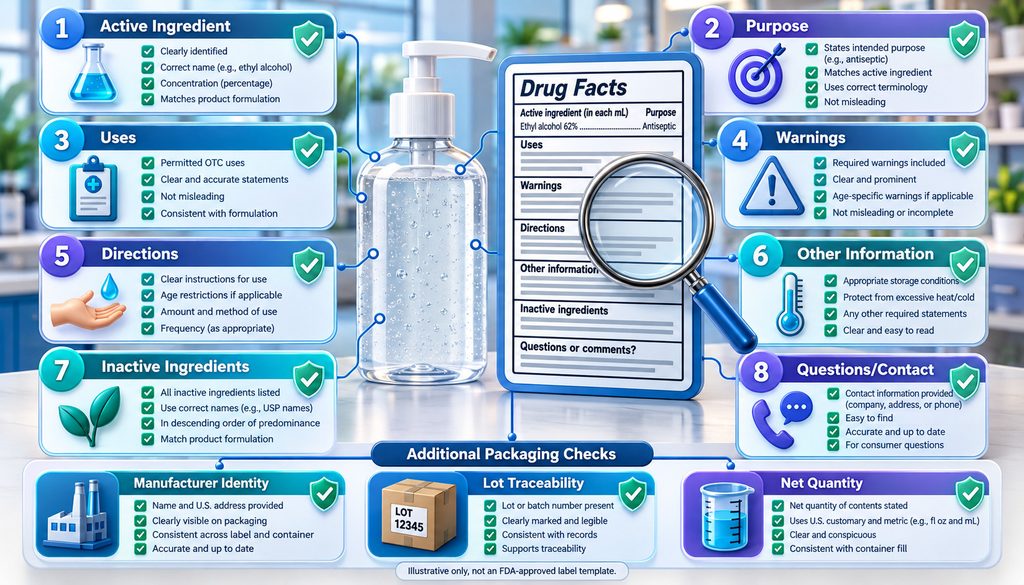
The Drug Facts panel provides standardized information to help consumers understand the product’s intended use and warnings.
Retailers should inspect the following elements:
| Label element | What to verify | Why it matters |
| Active ingredient | Ingredient name and concentration | Identifies the antiseptic substance |
| Purpose | Intended antiseptic function | Explains the drug’s role |
| Uses | Permitted consumer uses | Identifies the product’s intended application |
| Warnings | Relevant safety precautions | Helps prevent unsafe use |
| Directions | How to apply the sanitizer | Supports proper use |
| Other information | Applicable storage or other details | Helps consumers handle the product |
| Inactive ingredients | Required ingredient information | Supports transparency |
| Questions/contact | Required contact information | Enables product inquiries |
Also inspect the product identity, net quantity, appropriate responsible-firm identification, and other applicable labeling information outside the Drug Facts panel.
FDA’s Drug Facts labeling rules establish standardized content and formatting under 21 CFR 201.66. The layout and exact required statements depend on the product and applicable regulatory pathway.
The label should remain legible and match the product being supplied.
What About Alcohol Concentration?
Alcohol-based consumer hand sanitizers commonly use ethyl alcohol (ethanol) or isopropyl alcohol.
Consumers frequently encounter products containing at least 60% alcohol, but retailers should not treat a single concentration threshold as proof that any particular formulation is lawfully marketed.
The product’s intended use, active ingredient, concentration, formulation, labeling, and regulatory basis all matter.
For a more detailed discussion of the different types of sanitizer products, review how active ingredients in hand sanitizers influence formulation and product selection.
Retail buyers should be particularly cautious about products making unusually broad medical claims, such as guaranteed protection against specific diseases or claims suggesting FDA endorsement.
Does Every Hand Sanitizer Need FDA Approval?
No. Certain OTC drugs can be lawfully marketed without an individually approved new drug application when they meet an applicable OTC monograph framework and other requirements.
However, an NDC number, establishment registration, or drug listing does not independently prove a product is approved, compliant, or legally marketable.
That distinction is essential when screening manufacturers and wholesalers.
A supplier describing a sanitizer as “FDA registered” may be referring to an establishment or drug listing. Retailers should not interpret that phrase as a blanket FDA product endorsement.
Wholesale Hand Sanitizer Buying: How to Vet a Supplier
Reliable wholesale hand sanitizer buying starts with supplier verification, not a case-price comparison.
Two wholesalers may offer bottles that look nearly identical but differ substantially in traceability, remaining shelf life, storage history, minimum order quantities, and recall support.
A low price can quickly become expensive when a retailer cannot return unusable inventory or identify affected lots.
Request a Complete Product Information Package
Before placing a substantial order, ask the wholesaler for:
- Legal business name and contact details.
- Manufacturer and responsible distributor information.
- Exact product name and applicable NDC information.
- Current photographs of the complete retail label.
- Active ingredient and stated concentration.
- Lot identification and expiration information.
- Case size, unit quantity, and unit cost.
- Storage and shipping requirements.
- Product recall notification procedure.
- Written terms for damaged, expired, and recalled inventory.
Additional documentation may be appropriate depending on supplier risk, import status, or the product’s history.
For higher-risk or unfamiliar suppliers, buyers can also request relevant quality documentation and confirm it directly with the responsible manufacturer.
Do not rely entirely on screenshots of certificates, marketplace descriptions, or promotional assurances.
Understand FDA Registration and Drug Listing
Drug manufacturing establishments are subject to applicable FDA registration requirements, and relevant products must be listed as required.
Retail buyers can ask for the manufacturer’s registered establishment information and the exact product listing details.
However, registration and listing serve regulatory identification and oversight purposes. They do not certify that every product from the facility is safe or legally marketed.
A buyer should confirm that the supplier’s legal entity, manufacturing location, listed product, and actual bottle label are consistent.
If the manufacturer cannot identify the origin of the goods or explain who is responsible for the product, treat that as a serious purchasing concern.
Check FDA Safety Lists Before Buying
An essential step is searching the FDA’s list of hand sanitizers consumers should not use.
The list identifies products and manufacturers associated with concerns such as contamination, insufficient active ingredients, or other quality problems.
Search using the brand, manufacturer, distributor, or NDC information available on the packaging.
The FDA may identify additional products over time, so checking once when opening a wholesale account is not sufficient for an ongoing inventory program.
For retailers working with newer or unfamiliar brands, repeat the check before reorders and whenever safety notices appear.
Compare Supplier Offers Beyond the Bottle Price
| Supplier factor | What to evaluate | Why it matters |
| Unit cost | Price after discounts | Base purchase economics |
| Shipping | Freight and handling per unit | Actual landed cost |
| Shelf life | Time remaining upon delivery | Risk of unsold expiry |
| Minimum order | Units required per shipment | Capital tied up in stock |
| Returns | Unsold, damaged, short-dated goods | Potential financial recovery |
| Recall support | Lot tracing and supplier credits | Response speed |
| Label quality | Complete, readable OTC information | Resale compliance |
| Product mix | Travel, pump, spray, refill | Customer demand fit |
For example, a supplier charging $1.10 per bottle with reasonable shipping and dependable return terms may be preferable to a $0.85 offer requiring a much larger order with limited remaining shelf life.
The relevant number is the complete cost of purchasing, storing, rotating, and potentially disposing of the inventory.
The purchasing calculations discussed in buying hand sanitizer in bulk are useful when comparing case quantities and avoiding overbuying.
Watch for Wholesale Red Flags
A supplier deserves additional scrutiny when it cannot provide a consistent manufacturer identity, offers unusually short-dated merchandise without disclosure, or makes product claims that do not appear on the actual label.
Other warning signs include missing lot information, packaging that imitates beverages, inconsistent ingredient declarations, and an unwillingness to explain recall procedures.
Retailers should also examine whether imported products have appropriate labeling for the U.S. market.
Cheap inventory that cannot be traced is not a bargain when a safety notice requires immediate removal from sale.
A Practical Incoming-Shipment Inspection
Before placing newly received sanitizer on a sales floor, inspect a representative sample from each shipment and verify the accompanying records.
Retail hand sanitizer wholesale shipment inspection with bottle labeling, checklist and verification icons
Wholesale receiving: check the product label, manufacturer identity, packaging condition, lot records, and supplier documentation before releasing inventory for sale.
The receiving employee should check that bottles are properly sealed, readable, free from leaks, and consistent with the purchase order.
Lot and expiration information should be captured when available. If a shipment contains mixed lots, record each affected lot separately rather than assuming the entire case shares one production history.
Hold questionable goods outside saleable inventory until the supplier confirms their identity and status. A product should not reach the checkout display simply because the purchase order was received successfully.
Hand Sanitizer Expiration Stock Rotation: FIFO vs. FEFO
Shelf rotation has a direct effect on sanitizer profitability and product quality.
Products that remain unsold for too long may become difficult to sell even when their packaging is otherwise intact. Poor storage conditions can also damage containers and affect product stability.
Retailers need a consistent method for identifying which bottles should be sold first.
Does Hand Sanitizer Have an Expiration Date?
Many hand sanitizer products carry expiration dates supported by the manufacturer’s stability program.
Under FDA drug regulations, expiration dating generally reflects the period during which a drug is expected to maintain its specified quality when stored as labeled. A limited exception exists for qualifying OTC products without dosage limitations that have demonstrated at least three years of stability.
Retailers should not automatically conclude that a sanitizer without a printed expiration date is illegal, nor should they assume every sanitizer can be used indefinitely.
If expiration information is missing, unclear, or inconsistent with the wholesale documentation, request clarification from the responsible manufacturer before stocking the product.
For more information about how shelf life relates to product stability, see what hand sanitizer expiration dates mean.
Why FEFO Is Often Better Than FIFO
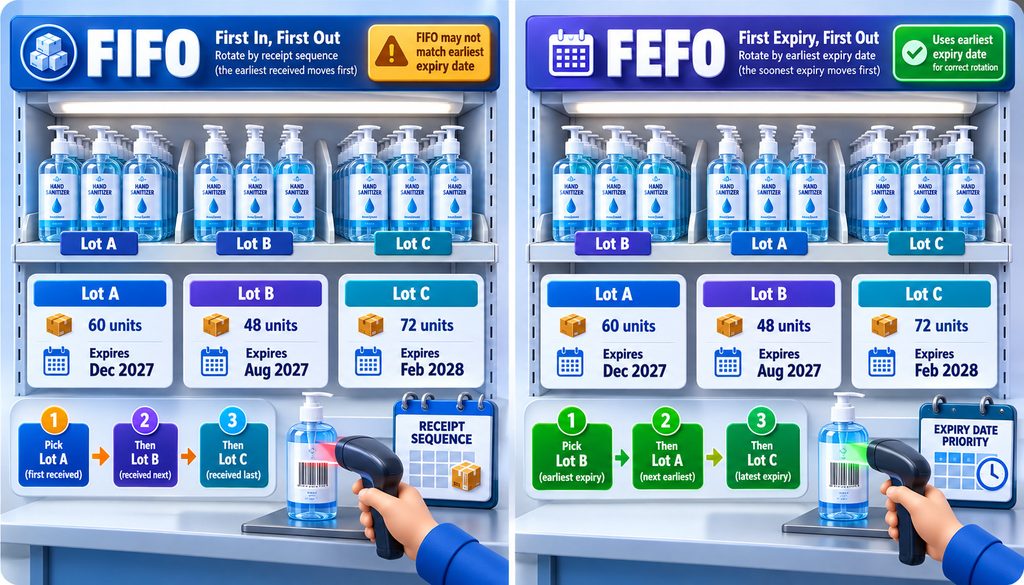
First-in, first-out (FIFO) means selling the oldest received stock first.
First-expired, first-out (FEFO) means prioritizing products with the earliest expiration date.
Both methods can work when incoming products have consistent shelf lives. However, FEFO is generally more useful when shipments contain different expiration dates.
Consider this example:
| Shipment | Received | Expiration | Units |
| Lot A | January 10 | December 2027 | 60 |
| Lot B | February 5 | August 2027 | 48 |
| Lot C | March 2 | February 2028 | 72 |
Although Lot A arrived first, Lot B expires earlier.
Under a FEFO system, eligible units from Lot B should be placed ahead of Lot A and Lot C, assuming they remain appropriate for sale.
This simple adjustment helps prevent older-expiring products from getting trapped behind newer stock.
Example Shelf Rotation Workflow
Hand sanitizer shelf rotation infographic showing older-expiring stock moving to the front and newer stock behind
Expiration-based shelf rotation: identify the earliest-expiring lot, place it at the front, and keep newer-expiring stock behind it.
A practical retail rotation procedure is:
- Record the product SKU, lot identifier, receiving date, and expiration date when available.
- Mark cartons so employees can distinguish different lots.
- Place earlier-expiring saleable stock toward the front of the shelf.
- Check the backroom before opening a new case.
- Review slow-moving products at least monthly, increasing frequency for short-dated stock.
- Quarantine expired, leaking, visibly damaged, or otherwise questionable units.
- Follow approved supplier-return or disposal procedures for unsaleable stock.
A small store may maintain lot records in a spreadsheet if its POS cannot handle batch-level inventory.
Larger retailers should consider inventory software that can track multiple lots and expiration dates under the same SKU.
How Much Remaining Shelf Life Should You Require?
There is no universal FDA rule that every retailer must receive hand sanitizer with a fixed number of months remaining before expiration.
Buyers can nevertheless establish contractual receiving standards based on anticipated sales velocity.
For example, a convenience store selling only 20 units a month should be cautious about ordering 400 units that expire in six months.
At that rate, selling all the units before expiration would be unlikely without a change in demand.
Wholesale terms might specify a minimum remaining shelf life at delivery, subject to the manufacturer’s actual shelf-life information and supplier agreement.
Make exceptions only when the reduced shelf life, lower price, and expected sell-through make commercial sense.
Storage Conditions Matter as Much as Rotation
Alcohol-based sanitizer is flammable and should be stored away from ignition sources, excessive heat, and direct sunlight, following its label and applicable fire-safety requirements.
Excessive heat, damaged seals, and poor handling can affect product quality.
Large backroom inventories may also create additional fire-code or hazardous-material storage considerations based on alcohol content, packaging, total quantities, and local requirements.
The storage methods covered in storing bulk hand sanitizers safely are useful when planning stockroom arrangements and larger-volume purchases.
Do not transfer sanitizer into unlabeled containers or mix different lots during ordinary retail handling.
Retailer Liability for Recalled Hand Sanitizer: What Happens When a Product Is Recalled?
A hand sanitizer recall can require immediate action even if a store purchased its inventory from an established wholesaler.
The merchant may have remaining stock on shelves, unopened cases in storage, and previously sold units in customers’ possession.
The first responsibility is protecting customers and following the applicable recall notice, not waiting for a supplier credit.
How Do Retailers Learn About Recalls?
Recall notices may come from the manufacturer, distributor, wholesaler, regulatory agency, or a retail compliance service.
FDA also publishes recall information and drug safety alerts, although a firm may begin a voluntary recall before the FDA’s final classification appears in enforcement records.
Retailers should maintain current supplier contact details and designate someone to review product-safety notifications.
The FDA’s do-not-use list and formal recall notices are related but not identical. A product can be subject to a safety warning without every detail appearing in the same database.
What to Do When Stocked Sanitizer Is Recalled
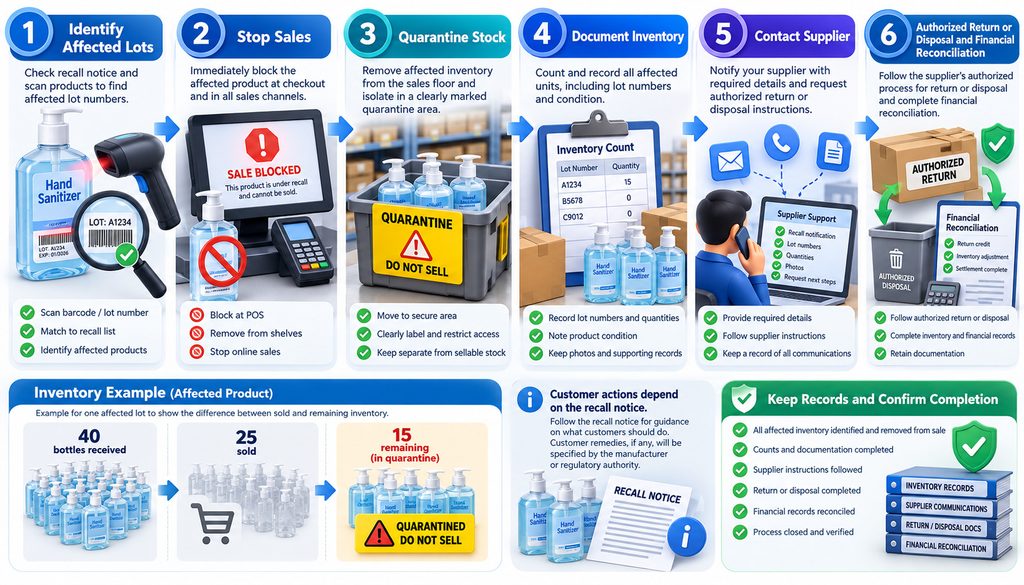
Follow this controlled response process.
Retailer checking hand sanitizer bottles for recall alerts and placing affected products into quarantine
Recall response: identify affected inventory, stop sales, isolate the products, preserve lot records, and arrange the documented supplier resolution.
- Confirm the exact affected product: Compare its brand, manufacturer, NDC, lot numbers, packaging, and other identifiers with the notice.
- Immediately stop selling affected stock: Block applicable POS SKUs or lots and notify employees.
- Quarantine the inventory: Remove it from customer-accessible shelves and label it clearly as not for sale.
- Count and document affected units: Record locations, quantities, lot references, invoices, and receiving dates.
- Contact the supplier or recalling firm: Request written instructions for returns, disposal, reimbursement, and customer notification.
- Review previously completed sales: Determine whether loyalty or customer purchase records can identify affected buyers without unnecessary disclosure of personal information.
- Follow the recall instructions: Do not independently relabel, repurpose, or resell affected inventory.
- Retain supporting records: Keep evidence of quarantine, returned or disposed quantities, communications, and financial recovery.
A generic “hand sanitizer recalled” notice should not automatically cause a retailer to discard unrelated brands. Conversely, a close name match should never substitute for checking the exact product and affected lots.
Who Refunds the Retailer for Recalled Sanitizer?
The answer depends on the supply agreement, the recall program, the nature of the defect, and applicable law.
In many cases, the retailer seeks a credit or reimbursement through the wholesaler or distributor that sold the inventory.
However, reimbursement is not guaranteed merely because a recall occurred.
The responsible manufacturer may operate a separate return or reimbursement program. Some agreements specify how freight, handling, disposal, and customer refunds are treated.
Before accepting a wholesale account, ask:
- Will the supplier issue a credit for confirmed recalled inventory?
- Is reimbursement based on wholesale cost or another formula?
- Who pays return shipping?
- Can the retailer destroy products locally with documented authorization?
- What evidence is needed to receive credit?
- Are unsold, expired, and recalled products treated differently?
Get the policy in writing. Verbal promises are difficult to enforce after a product is removed from sale.
Can a Retailer Be Liable Even If It Did Not Manufacture the Product?
Potentially, yes.
Product liability and consumer-protection obligations depend on state law, the retailer’s conduct, the distribution chain, and the circumstances of the claim.
Retailers can face disputes involving defective products, continued sales after notice of a recall, inaccurate advertising, or failure to follow relevant legal obligations.
A retailer may have contractual indemnification rights against a supplier, but those rights do not necessarily prevent a customer from making a claim.
Businesses should review applicable insurance coverage and obtain legal advice when material exposure arises.
For a small store, the most useful preventive measures are traceable sourcing, documented receiving checks, prompt removal of unsafe products, and reliable supplier records.
Customer Returns and Product Disposal
A consumer may ask for a refund after learning that a product was recalled.
The retailer should follow the manufacturer’s specific recall remedy, applicable law, and its customer service procedure.
In some recalls, customers may receive a refund directly from the recalling firm. Others involve returning goods to the retailer or distributor.
Do not assume recalled alcohol-based sanitizer belongs in ordinary trash or can be poured into a drain. Disposal requirements depend on its composition, quantity, contamination, and applicable environmental and fire-safety rules.
Retain proof of authorized disposal or shipment, especially when reimbursement depends on those records.
Wholesale Hand Sanitizer Prices and Retail Profit Margins
Retailers should evaluate sanitizer profitability using landed unit cost, expected selling price, sales volume, and potential inventory losses.
A case with an attractive discount may generate less profit than a smaller order if much of the stock expires before it sells.
There is no single dependable national wholesale price or standard margin for all hand sanitizers. Prices differ by brand, format, package size, supplier, order volume, and market conditions.
The figures below are illustrative pricing scenarios, not verified October 2026 wholesale market averages.
Example Wholesale-to-Retail Pricing by Format
| Retail format | Example landed cost | Example retail price | Gross margin |
| Travel-size bottle | $0.85 | $1.99 | 57.3% |
| Small spray bottle | $1.40 | $3.49 | 59.9% |
| Medium pump bottle | $2.75 | $5.99 | 54.1% |
| Large pump dispenser | $5.50 | $10.99 | 50.0% |
| Refill container | $8.00 | $14.99 | 46.6% |
These examples show how format and pricing affect gross margin. They are not recommended retail prices or guaranteed profit levels.
For actual purchasing decisions, request current supplier quotes and compare them with prices at competing retailers in your market.
How to Calculate Sanitizer Gross Margin
The basic formula is:
Suppose a store purchases a sanitizer bottle for $1.20 and spends another $0.15 per unit on inbound shipping and related purchasing costs.
Its landed cost is $1.35.
If the bottle sells for $2.99, gross profit per bottle is $1.64, giving a gross margin of approximately 54.8%.
Hand Sanitizer Margin Calculator
Enter your landed cost and retail price to calculate gross profit and gross margin automatically.
Enter a nonnegative cost and a selling price greater than zero.
Estimates are illustrative. Gross margin excludes operating expenses, shrinkage, and additional costs.
A higher margin is not always the best outcome. A product generating 40% margin and selling rapidly may contribute more total profit than a product generating 60% margin but remaining on shelves for months.
Markup and Margin Are Different
Retail buyers sometimes confuse markup with gross margin.
Markup uses cost as its denominator. Gross margin uses selling price.
A product costing $2 and selling for $4 has a 100% markup but a 50% gross margin.
When discussing sanitizer margins convenience store operators should use consistent definitions so supplier comparisons and store reports remain meaningful.
Account for Slow-Moving and Expiring Inventory
The true economics of wholesale sanitizer inventory depend on how many units sell before becoming unsaleable.
Imagine a retailer orders 200 bottles at a landed cost of $1.50 each.
The total investment is $300.
If only 140 bottles sell and the remaining 60 cannot be returned or sold before expiration, the retailer has $90 in unsold cost to address.
That loss can substantially reduce the profitability of the original purchase.
A purchasing decision should therefore consider likely demand, reorder frequency, supplier return rights, and shelf life alongside the expected margin.
Where to Merchandise Hand Sanitizer for Better Retail Sales
Hand sanitizer often fits into convenience-led purchasing behavior, making placement an important part of store planning.
Customers may purchase a small bottle because they forgot theirs, want something for travel, or are restocking a familiar household product.
A useful merchandising plan should reflect these shopping occasions rather than treating all sanitizer formats identically.
Checkout and Front-Counter Displays
Travel-size bottles and compact sprays are natural candidates for checkout merchandising because they require limited shelf space.
Position them where customers can see the product name, size, and price without blocking cashier activity or payment equipment.
Avoid placing alcohol-based products near ignition sources, excessive heat, or locations that conflict with fire-safety requirements.
A modest display containing a few frequently purchased options may perform better than a crowded counter with numerous nearly identical bottles.
Match Sanitizer Formats to Customer Needs
| Store location | Suitable formats to test | Likely shopping purpose |
| Checkout counter | Travel-size gel or spray | Convenience purchase |
| Personal-care aisle | Standard bottles and pumps | Routine household use |
| Travel accessories | Small, secure bottles | Bags and travel |
| Office or cleaning supplies | Large pumps and refills | Shared-use replenishment |
| Seasonal display | Selected portable formats | Travel or back-to-school demand |
The appropriate mix depends on the store's actual sales patterns.
For example, a convenience store near a transit station may sell more portable formats than a neighborhood hardware retailer serving local businesses.
For an explanation of how texture and packaging influence usage, see the differences between gel and spray hand sanitizers.
Seasonal Demand Without Overbuying
Sanitizer demand may change during respiratory-virus season, back-to-school shopping, travel periods, local events, and changes in workplace purchasing.
However, the size of those swings varies considerably by location.
Do not automatically double orders before every seasonal event.
Instead, compare previous-year sales, recent weekly velocity, current inventory, and remaining shelf life.
When historical sales are unavailable, begin with smaller orders and monitor results before expanding displays.
A simple sales-velocity calculation can help:
If a store has 120 bottles available and sells 20 each week, it has approximately six weeks of supply at the current sales rate.
That figure should be considered alongside incoming orders and expiration dates.
How to Ring Up Hand Sanitizer: Sales Tax and POS Inventory Controls
Retailers should configure hand sanitizer as a distinct product category in their point-of-sale system.
This makes it easier to review sales, margins, lot-level information, recalls, and potential tax differences from other merchandise.
Is Hand Sanitizer Taxable?
Hand sanitizer sales tax treatment depends on the state and sometimes local rules, as well as the product's legal classification and the conditions of any exemption.
A product being an OTC drug under FDA rules does not automatically make it exempt from sales tax.
Some jurisdictions provide exemptions for qualifying nonprescription drugs, while others tax those products or impose additional eligibility requirements.
Before creating a tax-exempt POS category, verify the rules with the relevant state revenue department or qualified tax adviser.
Also distinguish ordinary retail sales from purchases made under valid exemption certificates or other applicable special rules.
Avoid applying a general “medical product” exemption to every sanitizer SKU without verifying that the specific product and transaction qualify.
Recommended POS Product Fields
| POS field | Recommended information |
| Product name | Brand, format, and size |
| SKU | Unique internal product identifier |
| Barcode | UPC or other valid product code |
| Category | Hand sanitizer / applicable OTC category |
| Purchase cost | Current landed cost |
| Retail price | Approved selling price |
| Tax category | Verified jurisdiction-specific treatment |
| Vendor | Supplier identifier |
| Lot number | Batch reference where supported |
| Expiration date | Product date where applicable |
| Recall status | Available, blocked, or quarantined |
A POS without lot tracking may require a supplementary receiving ledger.
The ledger should connect a purchase invoice to the affected lot and identify the quantity received, sold, returned, or removed.
Why Lot Tracking Matters During a Recall
Suppose a retailer purchases 100 bottles across two manufacturing lots.
A recall affects only one lot.
If the POS stores only the total quantity under a single SKU, the merchant may struggle to identify exactly which units were affected.
With batch records, the store can identify the lot, receiving date, original quantity, and remaining stock more quickly.
Customer-level sales tracing may not always be available, especially for anonymous cash transactions. Retailers should therefore retain supplier documents and follow recall instructions appropriate to the available records.
Separate Discounts From Quality Decisions
Retailers may discount legitimate, saleable short-dated stock when permitted and commercially appropriate.
But a price reduction cannot make an expired, recalled, contaminated, or otherwise unlawful product suitable for sale.
A product blocked for safety reasons should remain blocked regardless of its promotional pricing.
The POS should prevent employees from overriding that restriction without authorized review.
A Practical Hand Sanitizer Retail Receiving and Stocking Checklist
A repeatable process is more dependable than expecting every employee to remember FDA rules or supplier-specific requirements.
Use this sequence for initial purchasing and routine replenishment.
Retail Stocking Readiness
0 of 12 completedTrack each receiving and stocking task.
A designated buyer or store manager should approve exceptions, especially when a supplier delivers short-dated products or incomplete documentation.
Keeping a receiving history also helps identify recurring supplier problems, including damaged cases, inconsistent lot information, and questionable expiration dates.
Common Retail Mistakes When Stocking Hand Sanitizer
Several avoidable mistakes create unnecessary inventory and compliance risk.
Buying based only on alcohol percentage. A stated concentration does not establish that the product meets all applicable drug requirements or is free from contamination.
Treating FDA registration as product approval. Registration and listing are not FDA endorsements.
Buying more inventory than the store can sell. Excess stock ties up cash and increases expiration-related losses.
Failing to record lot numbers. Without traceability, recalls become harder and potentially more expensive to manage.
Using first-in, first-out without reviewing expiration dates. A later shipment may have an earlier expiration date than stock already on shelves.
Assuming all OTC products are sales-tax exempt. Retail tax treatment varies by jurisdiction and product.
Continuing to sell products after receiving a safety notice. Potentially affected inventory should be promptly assessed and quarantined in accordance with the notice.
These mistakes can affect profit, customer trust, and regulatory exposure.
Frequently Asked Questions
Do I need an FDA license to sell hand sanitizer in my store?
An ordinary retailer selling finished, packaged hand sanitizer generally does not need to register as a drug manufacturer solely because it resells those products. However, applicable state licensing and drug-distribution rules should be checked. Manufacturing, repackaging, importing, relabeling, or wholesale distribution can involve additional requirements.
Does hand sanitizer need a Drug Facts label?
Hand sanitizers marketed as OTC antiseptic drugs generally need labeling that complies with applicable drug-labeling requirements, including the required Drug Facts information. Retailers should inspect labeling before accepting a shipment.
Does an NDC number mean the sanitizer is FDA approved?
No. An NDC identifies a drug listing but does not establish FDA approval, product safety, or lawful marketing on its own.
Can I buy hand sanitizer wholesale and resell it?
Yes, retailers can generally purchase lawfully marketed, properly packaged products from legitimate suppliers for resale, subject to applicable laws. Verify supplier identity, labeling, safety notices, inventory condition, and relevant state requirements.
Can I sell hand sanitizer without an expiration date?
Some qualifying OTC drug products can be exempt from displaying an expiration date under limited regulatory conditions. Do not assume the absence of a date automatically makes a product unlawful or acceptable. Ask the manufacturer for the applicable stability and labeling basis.
Should sanitizer be rotated using FIFO or FEFO?
FEFO, or first-expired, first-out, is generally preferable when products have different expiration dates. FIFO may be adequate when shelf life is consistent, but expiration dates should still be checked.
What should a store do with recalled sanitizer?
Stop selling the affected inventory, identify the relevant lots, quarantine products, document quantities, follow official recall instructions, and coordinate the appropriate return, refund, or disposal process.
Who pays for recalled inventory?
The answer depends on the supplier agreement, recall arrangements, and applicable law. Retailers should seek written reimbursement terms before purchasing substantial quantities.
What is a good retail margin on hand sanitizer?
There is no universal margin. The appropriate target depends on local competition, format, landed cost, sell-through, and expected inventory losses. Calculate actual gross margin from selling price and landed cost rather than relying on an unsupported industry average.
Is hand sanitizer exempt from sales tax?
Not automatically. State and local rules may distinguish among OTC drugs and other merchandise. Retailers should check the applicable revenue authority before applying an exemption.
Conclusion
Meeting reselling hand sanitizer retail requirements begins long before a bottle reaches the checkout counter.
Retailers should verify that products are lawfully marketed, inspect OTC Drug Facts labeling, confirm the manufacturer and wholesaler, and check FDA safety information before ordering. Each shipment should then be tracked by SKU and, where applicable, lot and expiration details.
Once inventory arrives, use expiration-based shelf rotation, appropriate storage, carefully controlled promotions, and a reliable recall procedure.
From a financial perspective, compare wholesale offers using landed cost, sell-through, gross margin, and potential losses from unsold or recalled stock rather than judging suppliers by case price alone.
Finally, configure the POS with accurate tax classifications, inventory records, and blocked-sale procedures so employees can manage sanitizer consistently.
The best retail sanitizer program is one where product safety, inventory rotation, pricing, and supplier accountability work together. That approach protects customers while giving stores a better chance of maintaining dependable margins.