Buying hand sanitizer in bulk can absolutely cut your per-use cost—but only if you treat it like a sourcing + quality-control project, not a quick “buy the biggest case online” decision.
The cheapest hand sanitizer in bulk is the one that (1) meets efficacy expectations, (2) arrives legally and safely shipped, (3) doesn’t evaporate in storage, (4) doesn’t get wasted through bad dispensers, and (5) won’t become a recall headache.
This guide breaks down exactly how to save money buying hand sanitizer in bulk while keeping quality high, reducing waste, avoiding scams, and future-proofing your purchasing plan. You’ll also see what to look for on labels, how to estimate demand, which channels typically price best, and how to negotiate bulk terms like a pro.
Define your bulk-buying goal and set a realistic budget

The fastest way to waste money on hand sanitizer in bulk is buying “a lot” without knowing what “enough” actually is. Bulk savings come from matching volume to real usage, then choosing the correct format and channel.
Start by writing down why you’re buying hand sanitizer in bulk: is it for an office, a storefront, a school, events, a fleet, or a multi-location operation? Each use case changes what “best value” means.
An event might need portable, single-use or travel sizes. A warehouse might need wall dispensers and refill jugs. A medical-adjacent setting might need fragrance-free gel with higher compliance emphasis.
Next, build a budget that includes more than the product price. If you’re serious about saving money buying hand sanitizer in bulk, include shipping, storage supplies (spill trays, shelves), dispensers/pumps, and shrink or waste.
Bulk orders are often hazmat-adjacent because alcohol-based products are flammable, which can change shipping costs and storage rules. You don’t want a “cheap” unit price that becomes expensive after freight surcharges or damaged product losses.
Finally, define your “must-haves” so you’re not upsold into premium features you don’t need. For many everyday settings, the most cost-effective hand sanitizer in bulk is a straightforward alcohol-based gel that meets mainstream guidance for alcohol percentage and is used correctly.
If your goal is strictly cost control, keep your spec tight: acceptable alcohol type, minimum alcohol percentage, and packaging format.
Build a demand forecast that prevents overbuying
A demand forecast is the core money-saver when buying hand sanitizer in bulk, because overbuying creates hidden losses: evaporation, leakage, pump failure, theft, and expired or degraded stock.
Forecasting doesn’t need fancy software—just disciplined assumptions. Estimate how many people will use sanitizer daily and how many times per day. For example: “40 people × 3 uses/day × 2 mL per use.”
Multiply by 30 days, then add a buffer for visitors or seasonal spikes. The point isn’t perfection—it’s to avoid the common mistake of ordering hand sanitizer in bulk based on emotion (“we never want to run out”) rather than math.
Volume-per-use matters more than most people think. Even high-quality sanitizer can underperform if people use too little. Health guidance notes that effectiveness depends on applying the right amount and rubbing hands until dry.
If your dispensers deliver too small a dose, users may pump twice (waste) or walk away half-covered (ineffective). That means your cost per effective use rises. The most economical hand sanitizer in bulk plan accounts for dose delivery: choose dispensers that provide consistent output, then teach users what “enough” looks like.
Also consider the difference between “inventory days” and “storage risk.” If you’re storing months of hand sanitizer in bulk, you’re also storing flammable liquid with packaging that can fail. It’s often cheaper long-term to buy slightly smaller bulk orders more often than one giant shipment that sits for a year.
Set quality requirements before you shop
If you want to save money buying hand sanitizer in bulk, set your quality bar first—otherwise you’ll compare products that don’t belong in the same category. Your spec should include:
- Minimum alcohol percentage (based on mainstream public guidance)
- Preferred alcohol type (ethanol or isopropyl)
- Format (gel, liquid, foam) based on where it will be used
- Skin tolerance needs (fragrance-free, dye-free, aloe/glycerin)
- Packaging (pump bottles vs. refills vs. cartridges)
- Supplier requirements (invoice, lot numbers, recall support)
Mainstream guidance recommends sanitizer with at least 60% alcohol when soap and water aren’t available. That one line should shape every bulk purchase decision: hand sanitizer in bulk that fails this threshold is not a bargain. It’s a waste.
Avoid “mystery brands” that don’t clearly list alcohol percentage, active ingredients, and responsible manufacturer information. If something goes wrong—bad smell, separation, skin irritation, or recall—you’ll want traceability. Bulk buying amplifies mistakes, so your quality checklist is where cost savings are protected.
Know what “effective hand sanitizer in bulk” actually means
To save money buying hand sanitizer in bulk, you need to understand what drives efficacy and what’s just marketing. A lot of bulk listings try to distract you with buzzwords like “hospital grade,” “professional,” or “advanced.” The fundamentals are simpler: alcohol level, correct use, and clean formulation.
Soap and water remain the best option in many situations, but alcohol-based sanitizer is recommended when soap and water aren’t available. Bulk buying is often about convenience: placing dispensers at entrances, carts, counters, and shared equipment areas. The goal is to increase consistent use, not just to stock a closet.
The most cost-effective hand sanitizer in bulk is the product people will actually use. If it smells harsh, leaves sticky residue, or dries skin badly, people avoid it—then your “cheap” purchase becomes dead inventory. This is why many bulk programs quietly “upgrade” to a better-feeling gel, because compliance improves and the cost per real use drops.
Alcohol percentage and why it affects your real cost per use
Alcohol percentage is non-negotiable if you care about performance. Mainstream public guidance says to use a hand sanitizer with at least 60% alcohol when soap and water aren’t available. When you buy hand sanitizer in bulk, check the label and listing for the exact percentage and whether it’s ethyl alcohol (ethanol) or isopropyl alcohol.
Here’s the cost trap: low-cost bulk sanitizer sometimes cuts corners by being sub-potent or inconsistently mixed. You might not notice until it feels watery or evaporates strangely fast.
If users sense it’s “weak,” they use more per application, which raises your consumption rate and destroys your bulk savings. In that scenario, paying a bit more for reliable hand sanitizer in bulk can lower total spend.
Also, alcohol-based products are flammable and produce flammable vapors at room temperature—something that matters when you store large quantities.
When you buy hand sanitizer in bulk, you’re not only buying a product—you’re taking on storage responsibility. Safe storage practices help you avoid losses, leaks, and “forced disposal” costs that erase your savings.
Gel vs. foam vs. liquid: choosing the cheapest option that people use
Many buyers assume the cheapest hand sanitizer in bulk is whatever has the lowest cost per ounce. But format affects how much gets used, how much gets wasted, and whether people like it enough to comply.
- Gel is common because it’s easy to dose, less likely to drip, and works well in pump bottles and wall dispensers. In bulk programs, gel often produces the lowest “mess cost,” meaning less cleanup and fewer slippery surfaces.
- Foam can feel nicer and spread easily, but dispensing systems can cost more and some foams use specialized cartridges. The product may be efficient per use if the dispenser output is controlled.
- Liquid can be cheapest by volume, but it spills easily and can create waste if users over-pour or if dispensers drip.
The money-saving approach is to test. Before committing to a pallet of hand sanitizer in bulk, run a two-week pilot with two formats in the real environment. Measure: how fast each gets consumed, how often dispensers clog or drip, and whether users complain. If the “cheapest” liquid consumes 30% faster due to spillage, it’s not actually the cheapest.
Finally, match format to location. For entrances and high-traffic areas, consistent dosing systems reduce waste. For personal carry or field staff, small bottles reduce leakage and theft. Your best savings come from mixing formats strategically rather than forcing one product everywhere.
Choose the best places to buy hand sanitizer in bulk
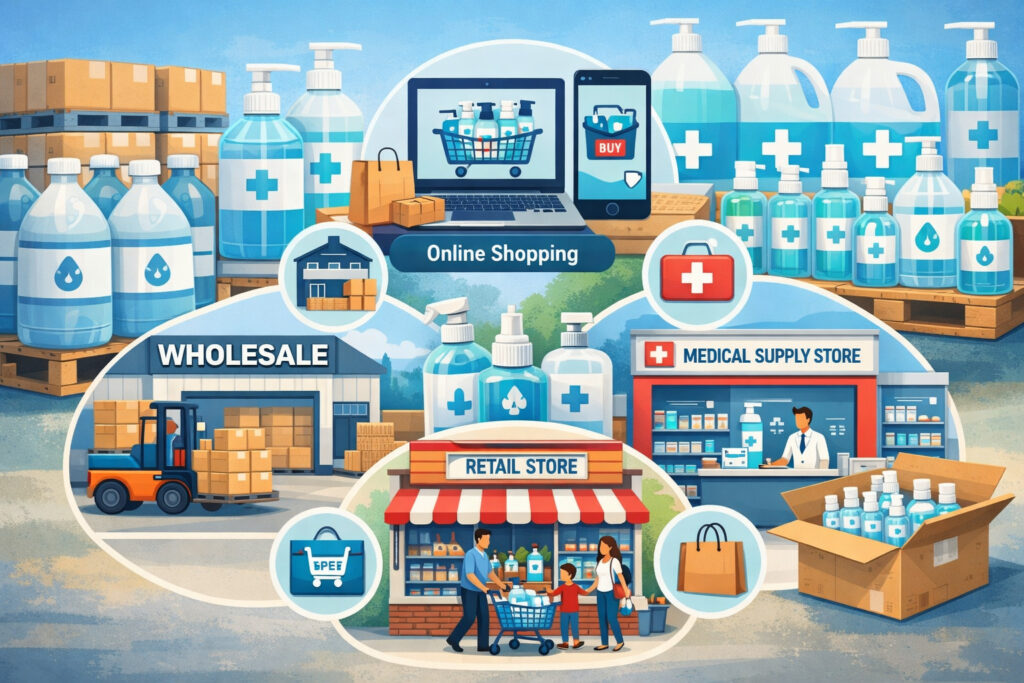
Where you buy hand sanitizer in bulk often matters more than which product you choose. Different channels have different pricing structures, minimums, shipping costs, and traceability. The best strategy is to shop by total delivered cost and risk, not just sticker price.
Think of bulk buying channels as three buckets: (1) wholesale distributors, (2) direct-from-manufacturer, and (3) large retailers/marketplaces. Each can be the “best” depending on your order size and how much you value documentation.
If you’re buying hand sanitizer in bulk for an organization, you may also need invoices, lot tracking, and supplier support for recalls. Some marketplaces can be inconsistent with seller quality. That’s not automatically bad—but your process should reflect the risk.
Also remember: if you need recurring supply, reliability is a form of savings. Running out forces emergency purchases at higher prices. A supplier with stable restock patterns can beat a cheaper seller who disappears for months.
Wholesale distributors: steady pricing and better documentation
Wholesale distributors are often the quiet winner for hand sanitizer in bulk if you buy regularly. Their pricing may not look as “flash sale” cheap as some marketplace listings, but they frequently offer better consistency, customer support, and the paperwork that makes recalls manageable.
When you buy hand sanitizer in bulk from a distributor, you can usually get:
- Case pricing, tiered volume discounts, and sometimes contract pricing
- Clear SKUs and consistent product specs
- Better shipping practices for bulk cartons (less damage)
- Invoices and lot/traceability support (varies by distributor)
This channel is especially valuable if your organization has compliance needs, audits, or internal procurement rules. It’s hard to put a dollar value on “not having a recall mess,” but one bad batch can cost more than a year of small savings.
The FDA has published guidance aimed at preventing hazards like methanol contamination in alcohol supplies used for sanitizer manufacturing and compounding—illustrating why supply integrity matters. Bulk buyers benefit when suppliers take quality control seriously.
To save money here, ask for a quote at multiple volume tiers (e.g., 10 cases, 25 cases, 1 pallet). You’ll often find a sweet spot where per-unit price drops sharply without requiring extreme storage.
Buying direct from manufacturers: best pricing at higher volumes
If you’re buying a lot of hand sanitizer in bulk, direct-from-manufacturer can offer the best unit economics—especially for refill jugs or large standardized SKUs. Manufacturers often discount heavily for pallet orders, multi-pallet orders, or scheduled releases.
The catch is that manufacturers may have minimum order quantities, longer lead times, and freight shipping instead of parcel delivery. If your receiving area isn’t prepared, you could incur extra fees (liftgate, appointment delivery, residential surcharge).
Saving money buying hand sanitizer in bulk directly is about negotiating the delivered terms, not just the product cost.
To make manufacturer buying work:
- Consolidate demand across locations before ordering
- Choose standardized packaging that fits your dispensers
- Negotiate freight terms and damage/return policies
- Request certificates or product spec sheets if available
- Confirm labeling meets your needs and that alcohol % is clear
Also think beyond today’s order. If you can commit to quarterly purchases, you may get better pricing than a one-off purchase. Scheduled buying is a classic hand sanitizer in bulk money-saver because it smooths demand and reduces supplier uncertainty.
Marketplaces and big-box channels: great deals, higher variability
Marketplaces and large retailers can offer excellent short-term deals on hand sanitizer in bulk, especially on overstock. But this channel has higher variability: third-party sellers, inconsistent inventory, and occasional “too good to be true” listings.
The money-saving play here is discipline: buy only listings with clear labeling, predictable seller reputation, and return-friendly policies.
A practical way to reduce risk is to buy a smaller test case first, then scale to hand sanitizer in bulk quantities once you verify the product: smell, texture, drying time, label accuracy, and packaging quality. If you’re buying for an organization, don’t skip traceability. Keep photos of lot numbers and purchase records.
Also watch for outdated references to old “do-not-use” lists. The FDA’s dedicated “hand sanitizers consumers should not use” page is no longer being updated and directs people to recalls and the recalls database instead. That means your buying process should include periodic recall checks rather than relying on a static list.
If you can find stable deals from reputable sellers, marketplaces can absolutely reduce costs for hand sanitizer in bulk—just treat it like sourcing, not impulse shopping.
Understand pricing so you can negotiate better bulk deals

Saving money buying hand sanitizer in bulk depends on understanding how sellers price: product cost, packaging cost, shipping cost, and their risk margin. If you only negotiate unit price, you may miss bigger levers like freight terms, volume tiers, bundling dispensers, or flexible delivery scheduling.
Start by converting every quote to “cost per effective use.” That means factoring in the expected dose size and likely waste. A product with better user acceptance can reduce over-dispensing. A leak-prone cap can shrink. This is why bulk buying is not only procurement—it’s operations.
Also be aware of timing. Demand spikes (seasonal illness surges, back-to-school, major event seasons) can move prices. Long-term savings come from building a repeatable process rather than chasing the lowest price once.
Calculate true unit cost: product + freight + waste
To truly save money buying hand sanitizer in bulk, track your landed cost:
- Product cost (per bottle, per gallon, per case)
- Freight/shipping (including surcharges)
- Receiving costs (labor, liftgate, appointment fees)
- Storage losses (leaks, evaporation, damage)
- Dispensing waste (drips, overuse, clogging)
This is where many bulk buyers lose the plot. They celebrate a low case price, then pay heavy shipping fees because alcohol-based products can trigger special handling and heavier cartons. If your order arrives damaged, your low unit cost disappears.
You can prevent that by negotiating packaging standards (extra corrugate, corner boards for pallets, shrink wrap quality) and clear damage-claim procedures.
If you’re buying hand sanitizer in bulk for multiple locations, consolidating shipments can reduce per-unit freight. But don’t over-consolidate into one massive delivery if it increases storage risk. There’s a balance: enough volume to earn discounts, not so much that you create shrink.
Finally, measure usage after switching products. If consumption rises unexpectedly, your new hand sanitizer in bulk choice may be causing waste through dispenser mismatch or user dissatisfaction.
Negotiation tactics that actually work for bulk sanitizer
Negotiating hand sanitizer in bulk is easier than many buyers think, because many suppliers expect it. The best leverage points are:
- Volume tiers: Ask for pricing at 3–4 quantities (cases, half pallet, full pallet, quarterly commitment).
- Delivery schedule: Offer flexible delivery dates in exchange for better pricing.
- Packaging and dispensers: Ask for free pumps, wall mounts, or dispenser cartridges as part of the deal.
- Payment terms: Some suppliers discount for faster payment; others discount for predictable reorder cycles.
- Substitution policy: Require that substitutes must match alcohol percentage and format, or no substitution without approval.
Be specific. “Can you do better?” is weak. “If we commit to 1 pallet per quarter for 12 months, can you reduce unit cost by 8% and include 24 wall dispensers?” is strong.
Also request samples or a small pilot. A supplier confident in their hand sanitizer in bulk offering will often support a trial because it reduces returns and disputes later.
Best times to buy and how to avoid panic pricing
One of the simplest money-saving moves is avoiding panic purchases. When demand spikes, prices jump and quality risk increases. Your goal is to buy hand sanitizer in bulk on your schedule, not the market’s emergency schedule.
Use reorder points. If you know you use 2 cases per week and lead time is 2 weeks, reorder when you hit 4–5 cases remaining. That prevents urgent rush shipping and last-minute “whatever is available” purchases.
Monitor seasonal patterns: back-to-school, cold/flu season, large public events, and year-end budget cycles can influence demand. Buying hand sanitizer in bulk slightly ahead of those peaks can save money.
Finally, avoid overreacting to news cycles. Instead, keep a modest buffer stock and rotate it. The most resilient bulk programs treat sanitizer like any other consumable inventory: forecast, reorder, rotate, and audit.
Reduce risk: compliance, recalls, and safety checks for bulk purchases
When you buy hand sanitizer in bulk, you’re multiplying both savings and risk. If you get a bad product, you don’t just lose a little—you lose cases, time, reputation, and sometimes safety. This section is about protecting your bulk savings with simple checks.
First, align with mainstream public guidance: use sanitizer with at least 60% alcohol when soap and water aren’t available. That’s your starting gate. Next, ensure the product label is clear and traceable. Then, store and handle it safely, because alcohol-based sanitizer is flammable and can create flammable vapors.
Also, remember that safety risk isn’t only “bad ingredients.” It can be microbial contamination in personal care products, packaging integrity issues, or supply chain substitution.
How to read labels and listings like a bulk buyer
A label-reading habit saves money buying hand sanitizer in bulk by preventing expensive mistakes. Look for:
- Active ingredient (ethyl alcohol or isopropyl alcohol)
- Alcohol percentage (clearly stated)
- Manufacturer or responsible company name
- Lot number / batch code
- Warnings (flammable, external use only)
- Directions (apply, rub until dry)
If a listing hides the alcohol percentage or uses vague language, skip it. Your savings depend on buying hand sanitizer in bulk you can trust and verify.
Also match packaging to your use: if you’re buying refill gallons, confirm compatibility with your dispensers and pumps. A cheap gallon that requires buying expensive pumps can erase savings.
In healthcare-adjacent settings, remember that effectiveness depends on using the right amount. That’s not only a health point—it’s a cost point. Consistent dosing reduces both underuse and overuse.
Avoid recall headaches and contaminated alcohol risk
Quality issues have been real in the sanitizer market. Guidance from federal regulators has addressed hazards like methanol contamination in alcohol supplies used for sanitizer production and compounding—underscoring that not all alcohol sources are equal.
For bulk buyers, the practical takeaway is: choose reputable suppliers, keep records, and be prepared to respond quickly if a recall hits your product category.
The FDA’s older dedicated “hand sanitizers consumers should not use” page is no longer being updated and points buyers to the recalls page and recalls database instead. Translation: your bulk buying process should include periodic recall checks, especially if you purchase from variable marketplace sellers.
There have also been recalls involving contamination with bacteria in certain hygiene and personal care products, reminding buyers that “sanitizing products” can still face quality problems.
A bulk buyer’s best defense is traceability: keep lot numbers, invoices, and distribution records so you can pull affected inventory fast if needed.
Saving money buying hand sanitizer in bulk includes saving the time and operational chaos of a messy recall response.
Storage and fire safety: protect product and prevent losses
Alcohol-based hand sanitizer in bulk is flammable and produces flammable vapors at typical indoor temperatures. That matters when you store cases in closets, warehouses, or back rooms. Poor storage can cause leaks, damaged cartons, and forced disposal—turning “bulk savings” into wasted spend.
Practical storage habits:
- Store in a cool, dry, ventilated area away from ignition sources.
- Keep product in original cartons as long as possible for protection and traceability.
- Use spill containment where large refills are stored.
- Rotate inventory: first in, first out.
- Inspect monthly for swelling bottles, leakage, or broken seals.
If you manage multiple locations, write a simple storage checklist and train managers. Bulk buying only saves money when the product stays usable.
Cut waste with smarter packaging, dispensers, and user habits
If you want the biggest savings from hand sanitizer in bulk, focus on waste reduction. Many organizations lose more money to sloppy dispensing and poor placement than they ever save through price negotiation.
Start with the user experience: where do people naturally pause? Entrances, near shared equipment, break rooms, checkouts, and meeting rooms. Place dispensers there, and you’ll use sanitizer more consistently—but also more efficiently, because people won’t pump extra “just in case” when a dispenser is awkward or half-empty.
Next, pick packaging that fits your environment. Bulk jugs are great, but only if you have reliable pumps. Cartridges are more expensive, but they often reduce leaks and dosing variance.
Choose dispensing systems that control dose and reduce mess
Dispensers are where hand sanitizer in bulk savings are won or lost. A good dispenser:
- Delivers a consistent amount per pump
- Doesn’t drip or clog
- Is easy to refill without spills
- Is durable in the real environment
Consistency matters because efficacy depends on applying enough product. But “enough” shouldn’t mean “a puddle.” Controlled dosing reduces overuse and mess, which reduces cleaning costs and product waste.
Test dispensers the same way you test sanitizer: pilot them. Measure how many uses you get per refill. If you switch dispensers and suddenly your consumption drops without complaints, you’ve found a hidden cost saver.
If you’re buying hand sanitizer in bulk in refill jugs, standardize pump types across locations. A mixed pump ecosystem creates training issues and increases spillage.
Refill strategy: when refill jugs beat bottles (and when they don’t)
Refill jugs often look like the cheapest hand sanitizer in bulk because the cost per ounce is low. But refilling has labor and waste costs: spills, sticky residues, and time spent refilling.
Refills are best when:
- You have high traffic and refill often
- Staff are trained and have a clean refill station
- You can standardize pumps and containers
- You track inventory so you don’t overstock
Pre-filled bottles or cartridges can be better when:
- Staff time is expensive
- You have many small locations
- You want minimal mess and consistent dosing
- Theft or tampering risk is higher
The cheapest approach is not universal. Many organizations save money by using refill jugs for back-of-house and cartridges for customer-facing areas. That hybrid model often delivers the best hand sanitizer in bulk economics.
Train users in a way that reduces both waste and underuse
Training sounds silly for sanitizer, but it’s one of the best ways to save money buying hand sanitizer in bulk. A tiny sign that says “Use 1 pump, rub until dry” can reduce double-pumping and improve consistency.
Mainstream guidance emphasizes rubbing hands until dry. When people use sanitizer correctly, they don’t feel the need to “top off” with extra product. That reduces consumption without reducing effectiveness.
If you manage staff, make it part of onboarding: where dispensers are, when to use them, and how to avoid waste. The goal is a habit loop: easy access, consistent dose, and normal use.
Master shipping, storage, and inventory so bulk savings don’t evaporate
You can negotiate an amazing price for hand sanitizer in bulk and still lose money through shipping damage, poor storage, and inventory confusion. Operations is the unglamorous side of saving money—but it’s where bulk programs succeed.
Start with shipping. Large orders may ship freight. Freight can be economical per unit, but only if you avoid accessorial fees and damage. Confirm whether the shipment needs a liftgate, whether delivery appointments cost extra, and what happens if cartons arrive crushed.
Then focus on storage and counting. Bulk buying creates the illusion of abundance, and abundance creates sloppy tracking. If you don’t know what you have, you reorder too early (overstock) or too late (panic buy).
Freight vs. parcel: reduce hidden fees and damage
If you’re buying hand sanitizer in bulk at pallet scale, freight will often beat parcel pricing. But freight comes with rules. Ask:
- Is it delivered to the dock, curbside, or inside?
- Is liftgate included?
- Are appointment fees included?
- What is the damage-claim process and time limit?
Damage is not rare with liquid products. The cheapest hand sanitizer in bulk is the shipment that arrives intact. Negotiate pallet protection: stretch wrap, corner boards, and clear labeling. Also request that cases are stacked in a way that prevents crushing lower layers.
If you’re not ready for freight receiving, consider ordering in smaller case lots through a distributor. Paying slightly more per unit can still be cheaper than paying multiple freight surcharges or losing product to damage.
Storage discipline: rotate stock and prevent product loss
Bulk storage needs routine. Alcohol-based sanitizer is flammable and must be stored safely, and poor storage can lead to leaks and waste. Create a “sanitizer zone” with shelves, spill trays, and a simple rotation rule.
Rotate stock monthly. Put newer shipments behind older ones. Inspect caps and seals. If you find leaks early, you can isolate the product before it ruins a full carton.
Also control access. In some workplaces, small bottles walk away. That’s not a moral judgment—it’s reality. If theft is an issue, switch to wall dispensers and keep bulk stock in a controlled area. Saving money buying hand sanitizer in bulk includes saving money from shrink.
Inventory systems that don’t require fancy software
You don’t need complex tools to manage hand sanitizer in bulk inventory. Use:
- A simple reorder point
- A monthly count
- A log of deliveries and distribution
- A standard order quantity
If you have multiple locations, assign one person per site to report inventory monthly. Centralize purchasing so you can negotiate better bulk terms and avoid each site panic-buying.
This simple discipline prevents the two biggest budget killers: overbuying and emergency buying.
Future outlook: how to keep bulk sanitizer costs low in the coming years
The best way to save money buying hand sanitizer in bulk long-term is to design a program that survives market swings: demand spikes, supply shifts, and changing product availability. While no one can predict exact pricing, you can predict the pattern: when demand surges, low-quality sellers multiply, and reliable inventory becomes more valuable.
Mainstream public guidance on sanitizer effectiveness has remained consistent: use sanitizer with at least 60% alcohol when soap and water aren’t available. That stability means your “spec” likely won’t need constant changes. The future-proof play is locking in reliable suppliers, keeping documentation, and maintaining a buffer stock that avoids panic pricing.
Also expect continued emphasis on product safety and recall awareness. The fact that older “do-not-use” pages are no longer updated and buyers are directed to recalls systems suggests ongoing reliance on recall infrastructure rather than static lists. Bulk buyers should build a quarterly recall check into procurement routines.
Trend prediction: more standardization, fewer “mystery” brands
A reasonable forward-looking expectation is that bulk buying will keep shifting toward fewer, more traceable suppliers—especially for organizations.
After years of quality variability, many buyers prioritize documentation and consistent specs, even if unit price is slightly higher. That pushes the market toward standardized SKUs, stable packaging, and contract supply.
For you, that means: if you find a hand sanitizer in bulk supplier that delivers consistent quality, it may be worth building a relationship rather than chasing the lowest spot price every time. Relationship pricing and predictable restocks often beat the chaos of rotating sellers.
Trend prediction: dispensing and placement will drive bigger savings than product price
Over time, many organizations will find the largest savings in hand sanitizer in bulk programs come from reducing waste and improving dosing—not squeezing suppliers for another 2%. Dispensers that control output, refill processes that prevent spills, and smarter placement reduce consumption while maintaining hygiene habits.
Because efficacy depends on using enough product, the goal won’t be “use less.” It will be “use the right amount consistently.” That’s where equipment choices become part of cost strategy.
Preparedness strategy: build a simple, repeatable bulk plan
Future-proof bulk purchasing looks like this:
- A standardized spec (alcohol %, format, packaging)
- Two approved suppliers (primary + backup)
- A reorder point and buffer stock
- A quarterly price check and recall check
- A dispenser standard and refill protocol
That’s how you keep hand sanitizer in bulk costs stable even when the market gets weird.
FAQs
Q.1: What is the cheapest way to buy hand sanitizer in bulk without sacrificing quality?
Answer: The cheapest way to buy hand sanitizer in bulk without sacrificing quality is to combine three moves: (1) lock a clear spec (alcohol percentage, format, packaging), (2) buy through a reliable channel with predictable shipping and documentation, and (3) reduce waste with proper dispensers and placement.
Start with the non-negotiable: mainstream guidance recommends sanitizer with at least 60% alcohol when soap and water isn’t available. Any “bulk bargain” that doesn’t clearly meet that threshold is not real savings. Next, compare suppliers by landed cost, not sticker price. Freight and damage can erase discounts.
Finally, protect your spending by controlling usage. If people double-pump because the dispenser output is inconsistent or because the product feels weak, your “cheap” hand sanitizer in bulk becomes expensive fast.
A practical best practice is a pilot: buy one case, test it for a week or two, then scale to bulk once you confirm user acceptance and packaging reliability. That approach prevents costly “pallet regret” and helps you build a repeatable sourcing process.
Q.2: How much hand sanitizer in bulk should I keep on hand?
Answer: The right amount of hand sanitizer in bulk depends on usage rate and lead time, not fear of running out. Forecast daily use: number of users × uses per day × dose size. Multiply by your reorder cycle, then add a safety buffer. If your supplier delivers in 10 days, carry enough for 3–4 weeks so you don’t panic-buy if a shipment is delayed.
Avoid storing extreme quantities unless you have safe storage capacity. Alcohol-based sanitizer is flammable and can create flammable vapors at room temperature, which matters when you stock large volumes. Overbuying increases loss risk (leaks, evaporation, damage). The money-saving goal is steady replenishment, not maximum stock.
If you have multiple locations, don’t let each location overstock independently. Centralize purchasing and distribute according to need. That alone can cut bulk sanitizer spend by preventing duplicate “just in case” inventory.
Q.3: How can I tell if a bulk sanitizer listing is risky or low quality?
Answer: Risky hand sanitizer in bulk listings often share red flags: unclear alcohol percentage, missing manufacturer identity, inconsistent labeling photos, unusually low price compared to the market, and vague claims like “kills 99.99%” without clear active ingredient details.
The simplest quality screen is label clarity: active ingredient type, alcohol percentage, directions, and traceable lot or batch identifiers. Mainstream guidance emphasizes at least 60% alcohol. If a listing avoids stating the percentage, treat it as a hard no.
Also, build a recall awareness habit. Some older FDA “do-not-use” pages aren’t being updated and direct buyers to recall resources instead. That matters for bulk buyers because traceability is everything. Keep invoices and lot numbers so if an issue arises, you can identify and remove affected stock quickly—protecting both safety and budget.
Q.4: Is gel or foam better for saving money buying hand sanitizer in bulk?
Answer: For saving money buying hand sanitizer in bulk, gel is often the best default because it dispenses predictably, is less likely to drip, and fits many common pumps and wall dispensers. Foam can be excellent too, especially when it improves user satisfaction and reduces over-dispensing, but it sometimes requires specialized cartridges and dispensers that raise total cost.
The money question isn’t “which is cheaper per ounce.” It’s “which delivers the lowest cost per effective use.” If users like foam more and use the correct amount without waste, foam can beat gel even at a higher unit price. If foam cartridges lock you into expensive refills, gel may win.
Because effectiveness depends on using enough product, dosing consistency matters. Choose the format that your dispensers can dose reliably, then standardize across locations to reduce leaks, refilling mistakes, and training confusion.
Q.5: What’s the best way to store large quantities safely and avoid product loss?
Answer: To store hand sanitizer in bulk safely and prevent loss, focus on temperature, ventilation, and packaging integrity. Alcohol-based sanitizer is flammable and can produce flammable vapors at room temperature.
Store bulk quantities away from ignition sources, in a cool, dry area, and keep products in original cartons to reduce damage and preserve traceability.
Prevent loss by rotating stock (first in, first out) and inspecting monthly for leaks, broken seals, or swelling containers. Use spill trays for refill jugs. Keep bulk inventory controlled to reduce shrink, especially if small bottles disappear.
From a cost perspective, storage discipline is one of the biggest hidden savings drivers. If 5–10% of your hand sanitizer in bulk inventory leaks or evaporates over time, you’ve lost more than most negotiated discounts would ever save.
Q.6: Should I sign a bulk supply contract or keep buying spot deals?
Answer: If your usage is steady, contracts often save more money buying hand sanitizer in bulk than chasing spot deals. Contracts stabilize price, reduce the risk of stockouts, and improve supplier accountability. They also make budgeting easier, which matters for organizations.
Spot deals can be great when you find reliable overstock pricing, but the risk is variability: inconsistent sellers, substitutions, and unclear traceability. If you go the spot route, you need a stricter quality checklist and more frequent verification.
A hybrid approach is often best: contract a core quantity from a reliable supplier (your baseline hand sanitizer in bulk need), then opportunistically buy additional cases when reputable deals appear. That keeps your program resilient without locking you into overpriced terms.
Conclusion
Saving money by buying hand sanitizer in bulk is not only about finding a low price—it’s about building a system that keeps costs low month after month.
The system starts with a demand forecast so you don’t overbuy, then a clear quality spec anchored in mainstream guidance (sanitizer with at least 60% alcohol when soap and water isn’t available).
From there, you choose the right purchasing channel, negotiate based on delivered cost, and protect your savings with safe storage and inventory discipline—especially since alcohol-based sanitizer is flammable and requires responsible storage at scale.
The biggest long-term wins usually come from reducing waste: better dispensers, smarter placement, standardized refill routines, and simple user guidance so people use the right amount consistently (effectiveness depends on using enough product).
And because recall information evolves, bulk buyers should keep documentation and periodically check recall resources rather than relying on outdated static lists.