By myhandsanitizershop February 7, 2026
Hand sanitizer ingredients matter more than most people realize. Two products can both say “hand sanitizer,” both claim to “reduce germs,” and still feel, smell, and perform very differently on your skin.
The difference is almost always in the hand sanitizer ingredients: the active ingredient type and percentage, the supporting solvents, humectants, thickeners, fragrances, and even trace impurities that can show up if quality controls aren’t tight.
This guide compares hand sanitizer ingredients side by side in a practical, label-reading way. You’ll learn how alcohol-based formulas differ from benzalkonium chloride formulas, why the “inactive ingredients” list is often the real story, and which hand sanitizer ingredients tend to be better for sensitive skin, frequent use, workplaces, schools, travel, and healthcare-adjacent settings.
You’ll also see how to evaluate safety and quality, including what regulators and public health agencies emphasize about alcohol percentage and when soap and water still wins. The CDC consistently notes that soap and water is best in most situations, and that when you do use sanitizer, you should choose one with at least 60% alcohol.
Because this is a “side by side” comparison, you’ll see repeated ingredient matchups throughout the article (ethanol vs isopropyl alcohol, gel vs foam, fragrance vs fragrance-free, glycerin vs aloe, and more).
If your goal is choosing the right product for your needs—and understanding what “good” hand sanitizer ingredients look like on a Drug Facts label—this will get you there.
Understanding the “Active Ingredient” Line: Where Effectiveness Starts
When comparing hand sanitizer ingredients side by side, the single most important line is the Active ingredient section on the Drug Facts label. This is the part that determines whether the product is primarily an alcohol-based hand rub or a non-alcohol antiseptic rub (most commonly benzalkonium chloride).
In practice, most effective retail products rely on alcohol, and the CDC’s consumer guidance points you to a sanitizer containing at least 60% alcohol when soap and water aren’t available.
Why does that matter? Alcohol’s germ-killing action is concentration-dependent and contact-time dependent. Too little alcohol can turn a “sanitizer” into something that feels clean but doesn’t reliably reduce germ load.
On labels, you’ll usually see Ethyl alcohol (ethanol) or Isopropyl alcohol listed with a percentage. Those percentages are not marketing decoration—they are the functional “dose” of the active ingredient.
Another key point: ingredient status and evidence requirements are shaped by the OTC drug framework. FDA materials explain that for consumer antiseptic rubs, FDA has historically focused on three active ingredients—ethyl alcohol, isopropyl alcohol, and benzalkonium chloride—and has described data gaps and studies needed to determine safety and effectiveness classifications.
This is one reason you’ll rarely see exotic antimicrobial activities in legitimate retail hand sanitizer ingredients.
If you compare two products and one lists “alcohol 62%” while another lists “alcohol 70%,” that looks like a small difference—but it can change evaporation speed, skin feel, and user compliance. Ingredient comparisons should always start with active type and percent, then move to the supporting cast of inactive hand sanitizer ingredients.
Ethanol vs Isopropyl Alcohol: Side-by-Side Ingredient Performance and User Experience
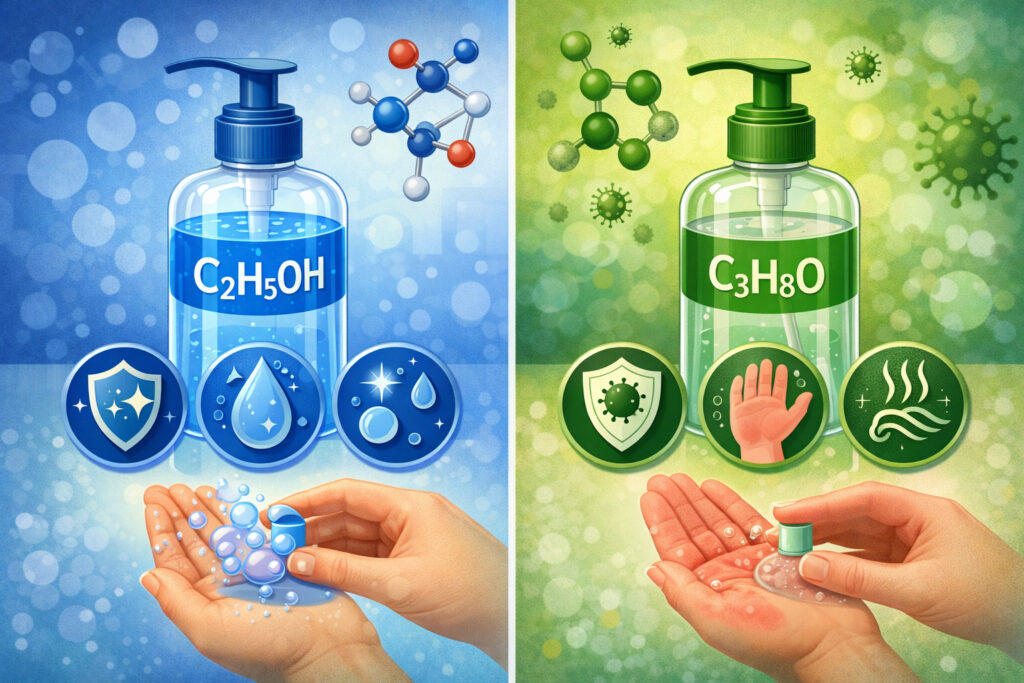
Ethanol and isopropyl alcohol are the two most common active hand sanitizer ingredients in alcohol-based rubs. Side by side, they share the same overall purpose: rapidly reducing many germs when used correctly.
The CDC’s consumer recommendation is framed around alcohol percentage (≥60%) rather than choosing one alcohol type over the other, because both can be effective when formulated properly and applied in adequate volume.
Where they differ for real-world use is in the sensory profile and formulation behavior. Ethanol-based products often have a lighter smell that many users associate with “clean,” and they can feel slightly less harsh in some formulas—especially when paired with humectants like glycerin.
Isopropyl alcohol often has a stronger “rubbing alcohol” odor and can feel more drying depending on the full hand sanitizer ingredients list. Neither is automatically gentler or harsher; the formulation choices matter more than the alcohol label alone.
Another practical side-by-side difference shows up in evaporation rate and how a gel “breaks” on the hands. Some isopropyl-heavy formulas flash off quickly, which can be great for fast-drying but can also lead to under-rubbing if users stop early.
This is why application instructions matter: rubbing until dry is part of effective use, and efficacy depends on applying enough product volume.
From a buying perspective, the best comparison habit is simple: pick the product that meets the alcohol threshold, feels acceptable for frequent use, and is easy to use correctly. If a sanitizer dries your skin so badly that you avoid using it, the “best” active ingredient becomes irrelevant. In ingredient comparisons, user compliance is part of effectiveness.
Benzalkonium Chloride vs Alcohol: When “Alcohol-Free” Hand Sanitizer Ingredients Make Sense
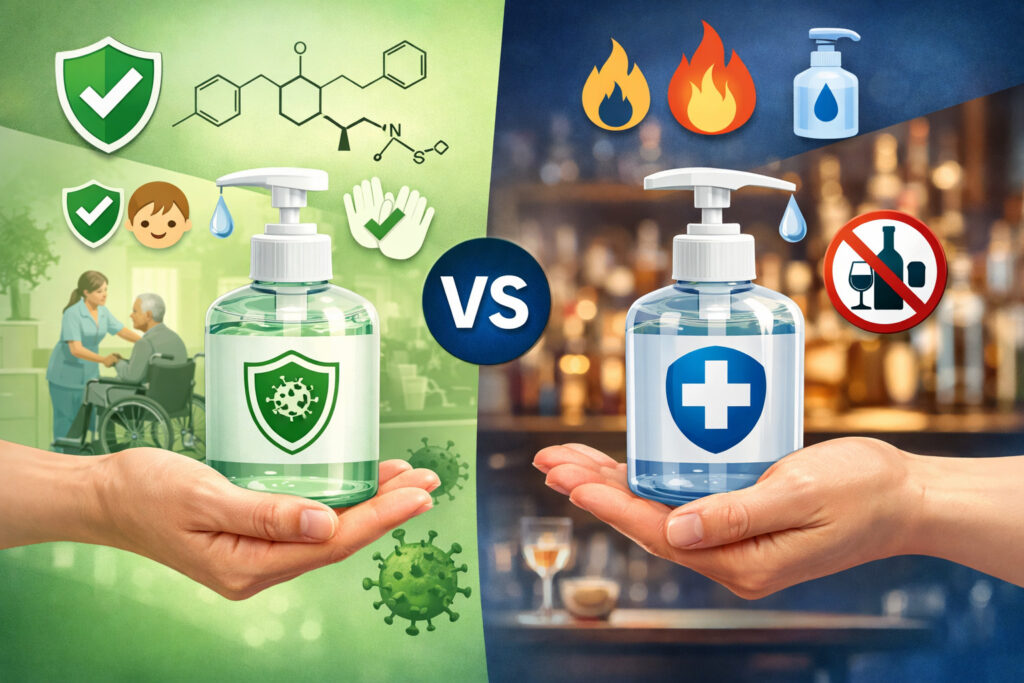
“Alcohol-free” hand sanitizer ingredients usually mean the active ingredient is benzalkonium chloride (BZK), a quaternary ammonium compound used in certain antiseptic products.
Side by side with alcohol-based hand sanitizer ingredients, BZK formulas often feel less drying, can have a smoother texture, and may be preferred by users who dislike alcohol smell or who have very dry hands.
However, ingredient comparison here must be more cautious. Public health messaging to consumers strongly emphasizes alcohol-based sanitizer (≥60% alcohol) when soap and water aren’t available, because alcohol-based rubs have broad evidence and established use patterns in many settings.
FDA background documents also describe how benzalkonium chloride, ethyl alcohol, and isopropyl alcohol have been central to the consumer antiseptic rub category, with discussion of evidence needed for final determinations.
So when do alcohol-free hand sanitizer ingredients make sense? Common scenarios include:
- Users with severe alcohol-related skin irritation, where a well-formulated BZK product improves compliance.
- Specific environments where flammability of high-alcohol products complicates storage and use (though many workplaces still manage alcohol-based sanitizer safely with proper handling).
- Preference-driven compliance, especially in schools or customer-facing counters where a gentler-feeling product gets used more consistently.
Still, the side-by-side takeaway is: if you’re choosing for general everyday germ reduction, alcohol-based hand sanitizer ingredients remain the simplest, most widely recommended choice—especially when you can verify alcohol concentration on the label.
Alcohol Percentage and Water Content: Why “60%” Is a Line You Should Treat as Non-Negotiable
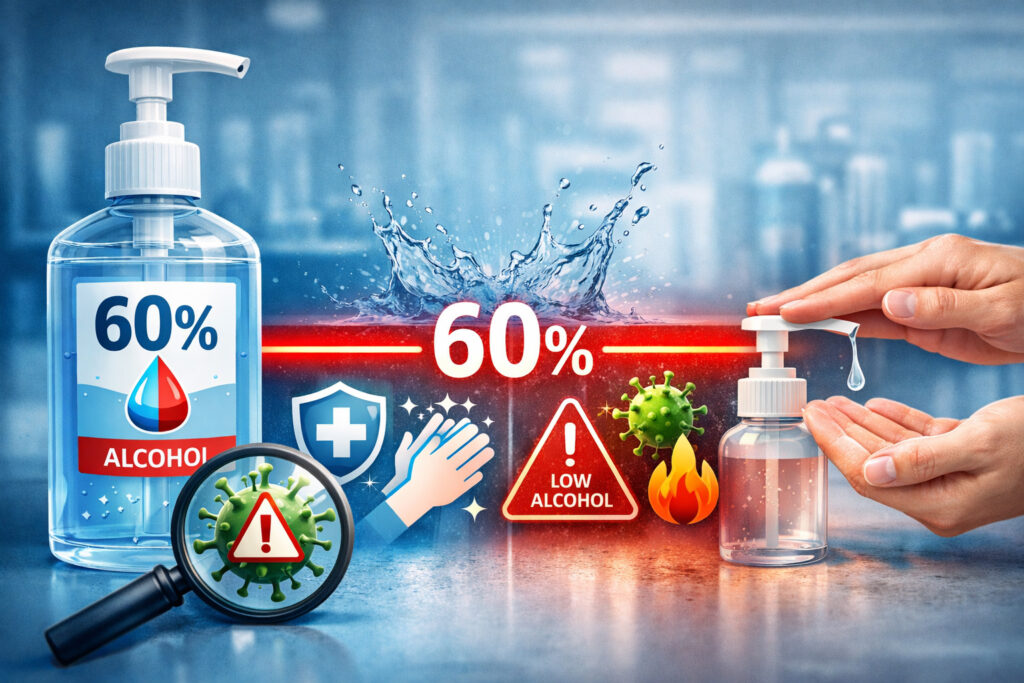
Among all hand sanitizer ingredients, alcohol percentage is one of the few label numbers that directly correlates with performance expectations for consumers.
The CDC recommends choosing a hand sanitizer with at least 60% alcohol when soap and water are not available. That threshold is practical: below it, products may not reliably reduce germ levels in typical consumer use, especially when hands are not rubbed thoroughly or long enough.
Side by side, a “60% alcohol” gel and a “70% alcohol” foam are not automatically better or worse than each other, but they behave differently. Higher-alcohol formulas often:
- Evaporate faster, which can shorten the natural rubbing time unless users are deliberate.
- Feel more drying unless counterbalanced with humectants.
- Smells stronger and can sting more on cracked skin.
Water content is the other half of the story. Alcohol-based hand sanitizer ingredients always include some water because water supports protein denaturation mechanisms that contribute to antimicrobial action.
In simple terms, “pure” alcohol isn’t automatically the best; a properly designed water-alcohol balance matters. What you can control as a buyer is making sure the label meets the ≥60% benchmark and that the product is pleasant enough to use correctly.
If you’re comparing hand sanitizer ingredients for families, the key is consistency: pick a formula that meets the alcohol guidance and doesn’t create a “hate to use it” barrier. When you use sanitizer, apply enough to cover all hand surfaces and rub until dry—volume and technique are part of effectiveness.
Humectants and Moisturizers: Glycerin, Aloe, Propylene Glycol, and the Skin-Feel Tradeoff
After the active ingredient, the most influential hand sanitizer ingredients are the humectants and emollients—the components that reduce dryness and improve skin feel. Side by side, these ingredients can make the difference between a sanitizer that causes cracked hands and a sanitizer that users apply frequently.
Glycerin (glycerol) is one of the most common humectants. It attracts water and helps reduce the drying effect of alcohol. In many formulas, glycerin improves comfort, but it can also make gels feel slightly tacky if used at higher levels.
Aloe (often aloe barbadensis leaf juice) is another popular ingredient that signals “soothing,” though the real moisturizing impact depends on the concentration and supporting ingredients. Propylene glycol and butylene glycol act as humectants and solvents, improving texture and spread.
Side by side, here’s how to think about these hand sanitizer ingredients:
- If your hands get very dry, look for glycerin and/or propylene glycol and avoid heavy fragrance.
- If you dislike stickiness, prefer foam formats or gels with lighter thickener systems.
- If you have sensitive skin, prioritize fragrance-free and dye-free formulas with a shorter inactive list.
This is also where ingredient marketing can mislead. A label might highlight “with aloe,” but the overall inactive profile could still include fragrance allergens or harsh denaturants. Ingredient comparison should always look beyond the hero ingredient callout.
For workplaces, the best “side by side” test is usage reality: if employees complain about residue, usage drops. Better hand sanitizer ingredients are the ones people will actually use multiple times a day.
Thickeners and Texture Builders: Carbomer, Cellulose, and Why Gel vs Foam Feels So Different
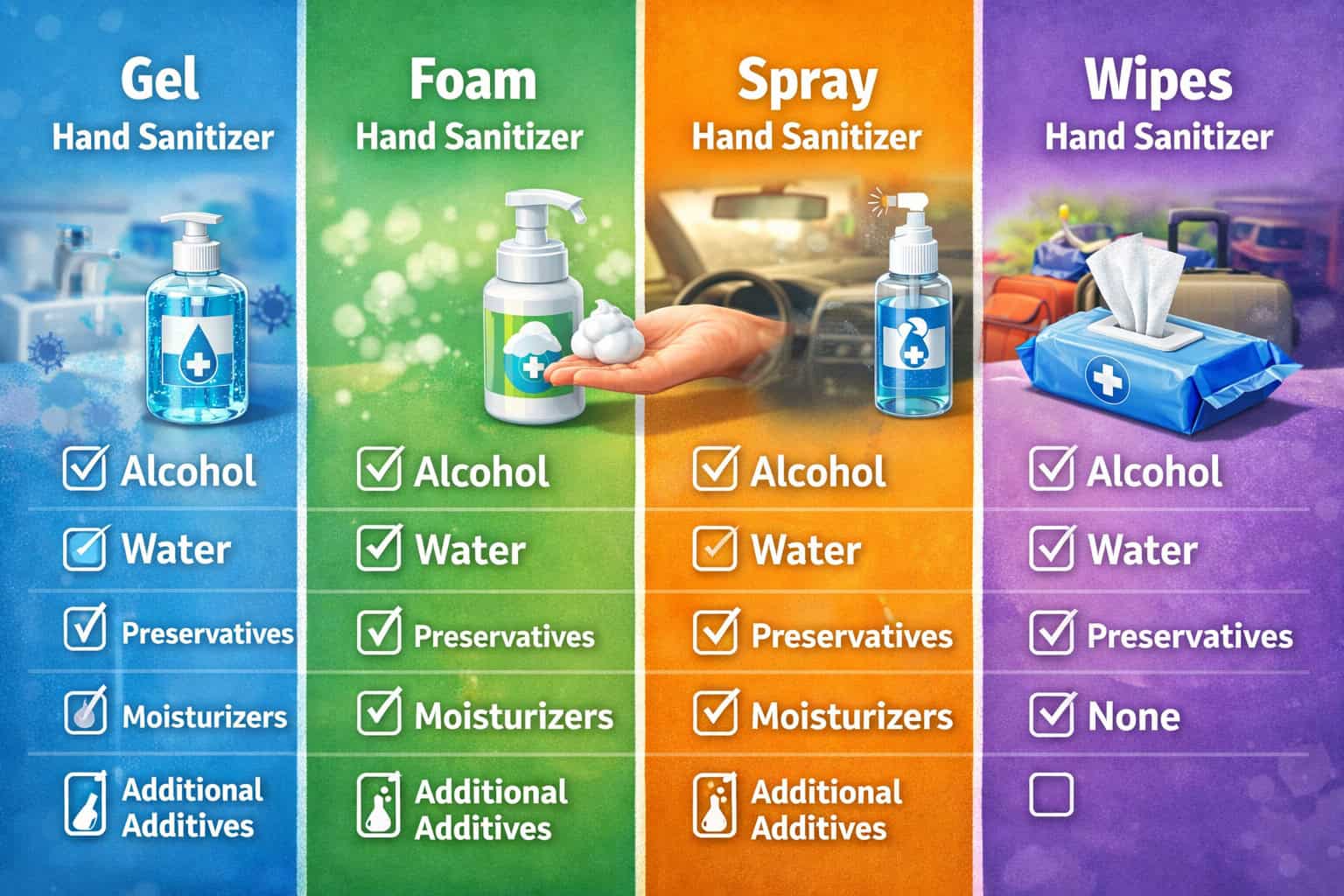
Gel, foam, and liquid sanitizers can contain the same active hand sanitizer ingredients but feel completely different due to rheology modifiers—thickeners and texture builders. Side by side, these ingredients don’t usually determine germ kill, but they strongly affect spreadability, dry time, and user satisfaction, which indirectly affects real-world performance.
Common gel thickeners include carbomer (a polymer that creates a clear gel) and cellulose derivatives (like hydroxyethylcellulose). Carbomer gels often need a neutralizer (like aminomethyl propanol or triethanolamine) to achieve the right viscosity. These systems can produce the classic “cool gel” feel many people expect in hand sanitizer ingredients.
Foams and sprays use different approaches. Foaming sanitizers may include surfactants and propellants or specialized pumps. Spray formulas often feel less sticky and can spread quickly but may drip if too thin.
Each format affects rubbing behavior: foams can encourage longer rubbing because they feel like they “disappear” gradually; thin liquids can run off the hands if users dispense too much.
If you’re comparing hand sanitizer ingredients for a business setting (front desk, retail counter, clinic-adjacent waiting area), texture is not trivial. People form instant preferences. The best ingredient profile is the one that supports consistent application and minimizes mess.
A practical side-by-side checklist:
- Gel: good control, familiar feel, can be sticky depending on glycerin and thickener balance.
- Foam: spreads easily, less drippy, often preferred for frequent use.
- Spray: fast, light feel, better for quick touch-ups, but can be misapplied if users don’t cover all surfaces.
Fragrance, Dyes, and Sensitizers: The Hidden Ingredients That Trigger Complaints
In many “hand sanitizer ingredients side by side” comparisons, the biggest difference isn’t ethanol vs isopropyl—it’s fragrance and dyes. These ingredients can be harmless for many users, but they are common reasons people report headaches, irritation, or “my hands got red and itchy.”
Fragrance is especially complicated because it’s usually a mixture of multiple components, and labels may simply say “fragrance” or “parfum.” If you have eczema, dermatitis, or sensitive skin, fragrance-free formulas are often the safer bet.
Dyes add no functional value to sanitation; they only change appearance. From an ingredient-quality standpoint, fewer unnecessary additives generally means fewer problems.
There’s also an important safety angle: strong scents can encourage unsafe behavior in households with children because scented sanitizer can be mistaken for candy or food.
Even though sanitizer is for external use, accidental ingestion is a known concern, and the safest product is the one treated like a medicine—stored appropriately and used under supervision.
Side by side, if you’re choosing for:
- Schools, families, or healthcare-adjacent environments: fragrance-free, dye-free is usually the best default.
- Retail counters: light scent might be acceptable, but avoid heavy perfume profiles that trigger customer complaints.
- Hospitality: some prefer a “signature scent,” but it can backfire for sensitive guests.
The more frequently a sanitizer will be used, the more valuable “boring” hand sanitizer ingredients become.
Denaturants, Bitterants, and “Special Additives”: What They Do and Why They Show Up
Many hand sanitizer ingredients lists include additives that exist for reasons other than skin feel. Denaturants may be used to discourage ingestion or to meet technical and regulatory constraints for alcohol use in products.
Bitterants are included to make the product taste unpleasant if someone tries to ingest it—helpful as a safety measure, especially in environments where accidental ingestion risk is higher.
Side by side, these additives can explain why one ethanol sanitizer smells harsher than another even at the same percentage. Some denaturants have strong odors. From a user experience perspective, harsher smell can reduce compliance; from a safety perspective, bitterants can reduce misuse.
You may also see chelators (like disodium EDTA), preservatives (more common in non-alcohol formulas), and pH adjusters. These ingredients help with stability, clarity, and shelf-life. While consumers often focus on “natural” callouts, stability ingredients can be a positive sign—meaning the product is formulated like a proper OTC drug, not a homemade mixture.
When comparing hand sanitizer ingredients, don’t automatically fear “chemical-sounding” names. Instead, evaluate:
- Is the active ingredient clear and meets guidance?
- Are there unnecessary irritants (heavy fragrance, dyes)?
- Does the formula have basic stability support (reasonable inactive list, standard functional excipients)?
This approach is more reliable than chasing buzzwords.
Quality, Contamination, and Impurities: Methanol, Benzene, and Why Source Matters
The most serious hand sanitizer ingredient issues aren’t about glycerin vs aloe—they’re about contamination and substandard manufacturing. Past regulatory actions and alerts have highlighted risks such as methanol contamination and concerns about contaminants like benzene in certain products.
FDA communications have warned about dangerous hand sanitizers and directed consumers to recall resources and databases (noting that some older “do not use” pages stopped being updated and pointing people toward recall tools).
Separately, regulatory-focused summaries have noted FDA attention to benzene contamination risks in certain products, with some hand sanitizers and aerosol products recalled due to benzene concerns.
The practical consumer point is this: quality systems matter. Two products can have the same “active ingredient: alcohol 70%” line and still differ in purity, odor, and safety if one has poor controls.
When comparing hand sanitizer ingredients for safety, look for:
- A complete Drug Facts label with clear active percentage.
- A recognizable manufacturer with traceable information.
- Purchase from reputable retailers with supply chain oversight.
If you’re evaluating products for an organization, it’s worth setting a basic procurement standard: require compliant labeling and be ready to check recall databases if a concern arises. If something smells like fuel, causes unusual irritation, or lacks a proper Drug Facts panel, treat that as a red flag.
This is also where “future prediction” matters: more routine impurity testing and tighter supplier qualification is likely to remain a focus as the market continues to mature and regulators emphasize manufacturing quality expectations.
Hand Sanitizer Ingredients for High-Frequency Use: Offices, Retail, Gyms, and Customer-Facing Counters
Choosing hand sanitizer ingredients for high-frequency use is a different problem than choosing a small travel bottle. When people sanitize dozens of times per day, the “best” formula is the one that balances effectiveness, comfort, speed, and acceptance.
Side by side, here’s what usually works best:
- Alcohol-based active ingredient at or above the CDC’s recommended threshold (≥60%).
- A humectant system (often glycerin and/or glycols) that prevents cracking.
- Minimal fragrance and no dyes to reduce complaints.
- A format that matches workflow: foam for quick spread, gel for controlled dispensing, spray for entry points (with training so it’s not misused).
The CDC also emphasizes that soap and water is best in most situations, so facilities should treat sanitizer as part of a bigger hand hygiene plan—sanitizer stations plus accessible sinks where feasible.
If you’re selecting a product for a front desk or a retail entrance, think about the “first impression” problem. Sticky residue, strong perfume, or slow dry time can reduce usage. In ingredient terms, that often means avoiding overly heavy glycerin levels and choosing a well-balanced gel or foam.
For gyms and high-touch environments, consider adding signage reminding people to rub until dry and cover fingertips and thumbs—behavior matters as much as hand sanitizer ingredients.
Reading Labels Like a Pro: Drug Facts, Claims, and Ingredient Red Flags
A side-by-side ingredient comparison is only as good as your label reading. A legitimate product should have a Drug Facts panel (because these products are generally regulated as OTC drugs in the United States). The Drug Facts panel helps you identify:
- Active ingredient type and percentage
- Intended use (for example, “hand sanitizer”)
- Warnings (flammability, external use only)
- Directions (apply, rub until dry)
- Inactive ingredients list
Red flags in hand sanitizer ingredients and labeling include:
- Missing active percentage (it should be clear).
- Vague claims without a Drug Facts panel.
- Products marketed as “sanitizer” but labeled like cosmetics, with no clear active ingredient statement.
- Unusually strong chemical odors or separation that suggests poor formulation.
Another common mistake is assuming “natural” equals safer or better. In reality, the best indicator is compliance and clarity. The CDC’s guidance is straightforward: if you use sanitizer, choose one with at least 60% alcohol. Pair that with a sensible inactive list (moisturizers, minimal irritants), and you have a solid product.
For organizations, it’s smart to standardize what “acceptable” looks like: require clear labeling, known activities, and avoid unnecessary fragrance if multiple users will share the same stations.
Future Trends in Hand Sanitizer Ingredients: What to Expect Next
Hand sanitizer ingredients aren’t static. Several trends are shaping what you’ll likely see more of in the next few years.
First, skin-friendly formulation will keep improving. As high-frequency use continues in workplaces and public spaces, brands have incentives to optimize humectants and reduce stickiness. Expect more sophisticated blends (multiple glycols, lightweight emollients) that maintain comfort without leaving residue.
Second, quality assurance and impurity monitoring will remain a priority. Regulatory attention to contamination risks and recalls supports continued focus on supply chain verification, impurity limits, and better batch testing, especially after past market disruptions.
Third, format innovation will continue: foams that spread faster, touchless dispensers, and packaging designed to reduce leakage and evaporation (which can change effective alcohol concentration over time if poorly sealed).
Finally, non-alcohol alternatives will likely persist but remain niche. Alcohol-free hand sanitizer ingredients can serve specific users and settings, but mainstream public health guidance for consumers continues to emphasize alcohol-based sanitizer thresholds when soap and water aren’t available.
The most realistic “future prediction” is not a radical new active ingredient, but better-designed, better-tested formulas that make correct use easier.
FAQs
Q.1: What hand sanitizer ingredients should I prioritize first?
Answer: Start with the active ingredient line. Look for alcohol-based hand sanitizer ingredients with at least 60% alcohol when soap and water aren’t available, consistent with CDC guidance.
Then prioritize supportive ingredients that prevent dryness (like glycerin) and avoid unnecessary irritants (heavy fragrance, dyes). This order matters because you want a product that is both effective and easy to use frequently without discomfort.
Q.2: Is “alcohol 70%” always better than “alcohol 60%”?
Answer: Not always. Both meet the CDC threshold if they’re at least 60% alcohol. Higher alcohol can dry faster and sometimes feel harsher. The best choice is the one people will apply correctly: enough volume, full hand coverage, rub until dry. Technique and compliance are a major part of real-world performance.
Q.3: Are alcohol-free hand sanitizer ingredients safe and effective?
Answer: Alcohol-free formulas commonly use benzalkonium chloride. They may be useful for certain users (like those who can’t tolerate alcohol), but consumer guidance strongly emphasizes alcohol-based sanitizer (≥60%) when soap and water aren’t available. If you choose alcohol-free, treat label clarity and reputable sourcing as essential.
Q.4: Which hand sanitizer ingredients are most likely to irritate skin?
Answer: Fragrance and dyes are frequent irritants, especially for sensitive skin. Alcohol itself can also irritate cracked skin, which is why humectants like glycerin matter. If you sanitize often, choose fragrance-free, dye-free products with moisturizing inactive ingredients. The “best” ingredient list is the one that doesn’t cause you to avoid using it.
Q.5: How can I reduce risk from contaminated or recalled products?
Answer: Buy from reputable retailers, check for a complete Drug Facts label, and use recall resources if there’s a concern.
FDA communications have directed consumers toward recall databases and tools, and Recalls.gov exists as a centralized portal for multiple agencies. If a product has a suspicious odor, causes unusual reactions, or lacks proper labeling, stop using it and check recall resources.
Conclusion
A side-by-side comparison of hand sanitizer ingredients isn’t about chasing one miracle formula—it’s about matching ingredients to your use case.
For most people, the most reliable baseline is an alcohol-based sanitizer that meets the CDC guidance of at least 60% alcohol when soap and water aren’t available. From there, the “best” ingredient list is the one that supports frequent, correct use: comfortable moisturizers, minimal irritants, and a texture format (gel, foam, spray) that fits your routine.
Pay close attention to the inactive hand sanitizer ingredients, because they drive skin feel, scent, residue, and whether people actually comply with good hand hygiene habits.
And don’t ignore quality signals: clear Drug Facts labeling, reputable sourcing, and awareness of recall resources matter because contamination risks—while not the norm—have been real enough to warrant ongoing attention and alerts.