By myhandsanitizershop January 7, 2026
Hand sanitizer is one of the simplest tools for reducing the spread of germs in everyday life. It’s portable, fast, and easy to use when a sink isn’t available. But “hand sanitizer” isn’t just one product.
There are multiple types of hand sanitizer, different active ingredients, different formats (gel, foam, spray, wipes), and different best-use scenarios. Some hand sanitizer options are ideal for busy workplaces and public-facing roles, while other hand sanitizer formulas are better for sensitive skin, travel kits, or high-frequency use.
This matters because the effectiveness of hand sanitizer depends on what it’s made of and how it’s used. Public health guidance consistently emphasizes that washing with soap and water is best in many situations, but when you can’t wash, an alcohol-based hand sanitizer with sufficient alcohol content is the go-to choice.
The CDC recommends using a hand sanitizer that contains at least 60% alcohol when soap and water are not available. The FDA also points consumers to the same core guidance and provides safety information on selecting and using hand sanitizer.
In this guide, you’ll learn the major types of hand sanitizer, how each type works, how to pick the right hand sanitizer for your needs, what to avoid, and what trends are shaping the future of hand sanitizer in homes and businesses.
Understanding What “Hand Sanitizer” Really Means
Hand sanitizer is a rub-on product designed to reduce microbes on hands when soap-and-water handwashing isn’t practical. Most hand sanitizer products fall into two broad categories: alcohol-based hand sanitizer and alcohol-free hand sanitizer.
Alcohol-based hand sanitizer typically uses ethanol (ethyl alcohol) or isopropyl alcohol as the active ingredient. Alcohol-free hand sanitizer often uses quaternary ammonium compounds (commonly benzalkonium chloride) as the active ingredient.
The key idea is that hand sanitizer is not a replacement for every kind of handwashing. Instead, hand sanitizer is a practical “in-between” option—especially in offices, retail counters, delivery settings, rideshare driving, travel, conferences, classrooms, and other situations where frequent contact happens but sinks are not always close by.
Effectiveness is tightly tied to formulation and technique. A hand sanitizer that is under-dosed in alcohol, applied too quickly, or wiped off before it dries is far less effective. That’s why reputable guidance stresses checking the label and using enough hand sanitizer to cover the entire surface of your hands.
The CDC’s consumer guidance highlights that soap and water are best in most situations, but if they’re unavailable, choose a hand sanitizer with at least 60% alcohol and follow label directions.
Another important part of understanding hand sanitizer is recognizing limits. Some germs are harder to inactivate with hand sanitizer than with washing. In those cases, reaching for soap and water is the smart move.
This doesn’t make hand sanitizer “bad”—it means hand sanitizer has a specific role and works best when you use the right type of hand sanitizer at the right moment.
How Hand Sanitizer Works Against Germs
Hand sanitizer works by using chemical action to disrupt microbes on the skin’s surface. Alcohol-based hand sanitizer is broadly effective because alcohol can break down lipid membranes and denature proteins, which disables many pathogens.
That’s one reason alcohol-based hand sanitizer is often recommended for general use when soap and water aren’t available.
Alcohol-free hand sanitizer works differently. Benzalkonium chloride (a common alcohol-free active ingredient) targets cell membranes in a different way than alcohol. Alcohol-free hand sanitizer can be useful in some settings, but performance can vary by organism, formulation, and real-world conditions.
This is why many public-facing recommendations still emphasize alcohol-based hand sanitizer as the default choice when you need a quick clean and cannot wash.
No matter which hand sanitizer you choose, contact time matters. If you apply hand sanitizer and immediately wipe it off, you reduce effectiveness. If you use too little hand sanitizer and miss fingertips, thumbs, and nail beds, you leave high-risk areas untreated.
The best hand sanitizer routine is the one you’ll actually follow—consistently and correctly—without causing skin irritation that makes you avoid using it.
Alcohol-Based Hand Sanitizers: The Most Common Type
Alcohol-based hand sanitizer is the most widely used type of hand sanitizer in public spaces and workplaces. This category usually includes ethanol-based hand sanitizer and isopropyl-based hand sanitizer.
Alcohol-based hand sanitizer is popular because it tends to work quickly, dries fast, and has strong real-world performance when used properly.
A major selection rule is alcohol concentration. The CDC recommends choosing a hand sanitizer with at least 60% alcohol when soap and water aren’t available.
This threshold is not a marketing detail—it’s a performance line. Alcohol content below that can reduce how well a hand sanitizer works. That’s why reading the Drug Facts label (or equivalent label information) is part of smart hand sanitizer shopping.
Alcohol-based hand sanitizer is also used heavily in professional settings through dispensers—think foam dispensers in lobbies, gel dispensers near elevators, and wall units at entrances.
These are typically alcohol-based hand sanitizer products because they provide fast, broad coverage for everyday interactions.
However, alcohol-based hand sanitizer has downsides: it’s flammable, it can dry out skin, and it should be stored responsibly. In homes with children, alcohol-based hand sanitizer should be treated like any other high-risk household product—used with supervision and stored out of reach.
Ethanol Hand Sanitizer: Pros, Cons, and Best Use Cases
Ethanol hand sanitizer (ethyl alcohol hand sanitizer) is a common alcohol-based hand sanitizer found in consumer and commercial products. Ethanol-based hand sanitizer is frequently chosen because it can be effective across a wide range of organisms when formulated correctly and used as directed.
One advantage of ethanol hand sanitizer is user experience. Many people find ethanol-based hand sanitizer has a familiar feel and consistent dry time.
Ethanol hand sanitizer is widely available in gels and foams, and it fits well in dispensers for workplaces. If you manage a facility, ethanol hand sanitizer often becomes the “standard issue” hand sanitizer because staff and customers recognize it.
The downside is the same for most alcohol-based hand sanitizer products: repeated use can dry skin. That doesn’t mean you should stop using hand sanitizer when it’s needed, but it does mean you should pair frequent hand sanitizer use with skin care strategies (we’ll cover this later).
Another practical point is that ethanol hand sanitizer must be allowed to dry. If you apply ethanol hand sanitizer and then immediately touch paper towels, clothing, or surfaces that wipe it away, you reduce the benefit of using hand sanitizer at all.
For selection, always verify the alcohol percentage on the label, and prioritize products with clear ingredient listing and reputable sourcing. The CDC’s recommendation for at least 60% alcohol applies broadly to alcohol-based hand sanitizer choices.
Isopropyl Alcohol Hand Sanitizer: Where It Fits
Isopropyl alcohol hand sanitizer is another leading type of alcohol-based hand sanitizer. Isopropyl-based hand sanitizer is extremely common in institutional buying because it performs well, is straightforward to formulate, and works effectively when applied correctly.
In day-to-day life, you might notice isopropyl alcohol hand sanitizer more often in larger refill jugs, contractor-size containers, and workplace dispensers. Many facilities like isopropyl alcohol hand sanitizer because it’s consistent across batches and often comes in large-volume packaging.
From a user perspective, isopropyl alcohol hand sanitizer can feel slightly different than ethanol hand sanitizer. Some users notice a stronger odor, which can influence compliance—especially in environments like classrooms or retail floors where frequent hand sanitizer use happens.
This is why facilities sometimes test both ethanol-based hand sanitizer and isopropyl-based hand sanitizer and choose the one people will actually use regularly.
As with all alcohol-based hand sanitizers, check the concentration and follow technique. Alcohol-based hand sanitizer should cover all surfaces of hands and be rubbed until dry. The CDC and FDA both emphasize using alcohol-based hand sanitizer at an effective alcohol percentage when soap and water aren’t available.
Alcohol-Free Hand Sanitizers: When and Why People Choose Them

Alcohol-free hand sanitizer generally refers to products that do not use ethanol or isopropyl alcohol as the active ingredient. The most common alcohol-free hand sanitizer active ingredient in consumer products is benzalkonium chloride.
Alcohol-free hand sanitizer is often marketed for sensitive skin, for reduced odor, or for environments where flammability is a concern.
Alcohol-free hand sanitizer can be appealing in settings where people complain about dryness from alcohol-based hand sanitizer. It can also be preferred by users who dislike the smell of alcohol-based hand sanitizer.
However, it’s important to understand that alcohol-free hand sanitizer performance can vary depending on the microbe, the product formulation, and how it’s used.
When comparing alcohol-free hand sanitizer to alcohol-based hand sanitizer, many health recommendations still put alcohol-based hand sanitizer first for general use because of its broad effectiveness and strong evidence base.
The FDA’s consumer guidance points people to alcohol-based options and safe use practices, reflecting mainstream public health positioning.
Alcohol-free hand sanitizer isn’t “useless”—it’s simply a different tool. The smart approach is to match the hand sanitizer type to your situation and risk profile.
For example: if you’re in a low-risk environment but need frequent use and your skin reacts badly to alcohol-based hand sanitizer, an alcohol-free hand sanitizer might improve compliance. In a high-risk setting, you may prefer alcohol-based hand sanitizer as the default.
Benzalkonium Chloride Hand Sanitizer: What It Is and What to Know
Benzalkonium chloride hand sanitizer (often abbreviated BZK hand sanitizer) is the most common alcohol-free hand sanitizer type. Benzalkonium chloride is a quaternary ammonium compound used in various antiseptic and disinfecting applications, including certain hand sanitizer products.
A practical advantage of benzalkonium chloride hand sanitizer is skin feel. Many people report less immediate dryness compared with frequent alcohol-based hand sanitizer use. Another advantage is reduced flammability compared with alcohol-based hand sanitizer, which can be relevant in certain storage environments or industrial contexts.
But there are trade-offs. The effectiveness of benzalkonium chloride hand sanitizer can be organism-dependent, and performance depends heavily on the specific formula and testing.
There is published research comparing benzalkonium chloride hand sanitizer and alcohol-based hand sanitizer in specific clinical contexts, showing that results can differ by conditions and endpoints.
This is why many organizations still stock alcohol-based hand sanitizer as the mainline option, sometimes offering alcohol-free hand sanitizer as an alternative for people with skin sensitivity.
If you choose benzalkonium chloride hand sanitizer, look for clear labeling, reputable manufacturers, and usage directions that match your environment. And remember: even the best hand sanitizer doesn’t replace soap and water when hands are visibly dirty or greasy, or after situations where washing is strongly preferred.
WHO-Style Formulations and Locally Produced Hand Sanitizer

A distinct “type” of hand sanitizer is locally produced or compounded hand sanitizer made using standardized formulations. During shortage periods, many institutions explored local production approaches, often guided by well-known WHO-recommended handrub formulations.
These formulations are widely referenced because they’re transparent, ingredient-specific, and designed around achievable production with proper safety controls.
The WHO guide describes two core formulations built around alcohol (either ethanol or isopropyl alcohol) plus glycerol (a humectant) and hydrogen peroxide (used to inactivate contaminating bacterial spores in the solution, not as the primary hand antiseptic).
This category is still relevant today because it helps people understand what “good” hand sanitizer composition looks like and why certain ingredients appear on labels.
That said, local production is not the same as casual DIY. Producing large volumes of alcohol-based hand sanitizer raises safety issues: flammability, ventilation needs, correct dilution, and quality control.
The WHO guide explicitly discusses safety constraints and production considerations such as limiting batch size in certain contexts.
For everyday consumers, the best takeaway is not “make your own hand sanitizer,” but “understand what quality hand sanitizer contains.” Transparent formulations provide a reference point for evaluating whether a hand sanitizer label looks legitimate, especially when shopping online or buying from unfamiliar suppliers.
What’s Inside WHO-Recommended Handrub Formulations (and Why It Matters)
The WHO-recommended handrub formulations are important because they clarify what actually makes an alcohol-based hand sanitizer effective.
The guide specifies final concentrations such as ethanol 80% (v/v) in one formulation and isopropyl alcohol 75% (v/v) in the other, along with glycerol 1.45% (v/v) and hydrogen peroxide 0.125% (v/v).
These details matter for two reasons. First, they show that effective hand sanitizer is not “a little alcohol mixed with gel.” Effective hand sanitizer has defined ranges and is built around performance, not cosmetics.
Second, they help explain why random DIY recipes are unreliable. If the alcohol percentage is too low after mixing, the resulting hand sanitizer may not work as expected.
The WHO document also highlights practical concerns: storage conditions, flammability, and the need for appropriate production environments.
In real-world terms, this is a reminder that alcohol-based hand sanitizer behaves like a flammable chemical product. Proper packaging, labeling, and storage are part of “hand sanitizer safety,” not optional extras.
If you’re responsible for procurement in a workplace, understanding these formulation principles helps you ask better questions: What’s the alcohol percentage? Is it ethanol or isopropyl? Is the supplier reputable? Does the labeling look compliant and consistent? Those checks reduce the risk of ending up with low-quality hand sanitizer.
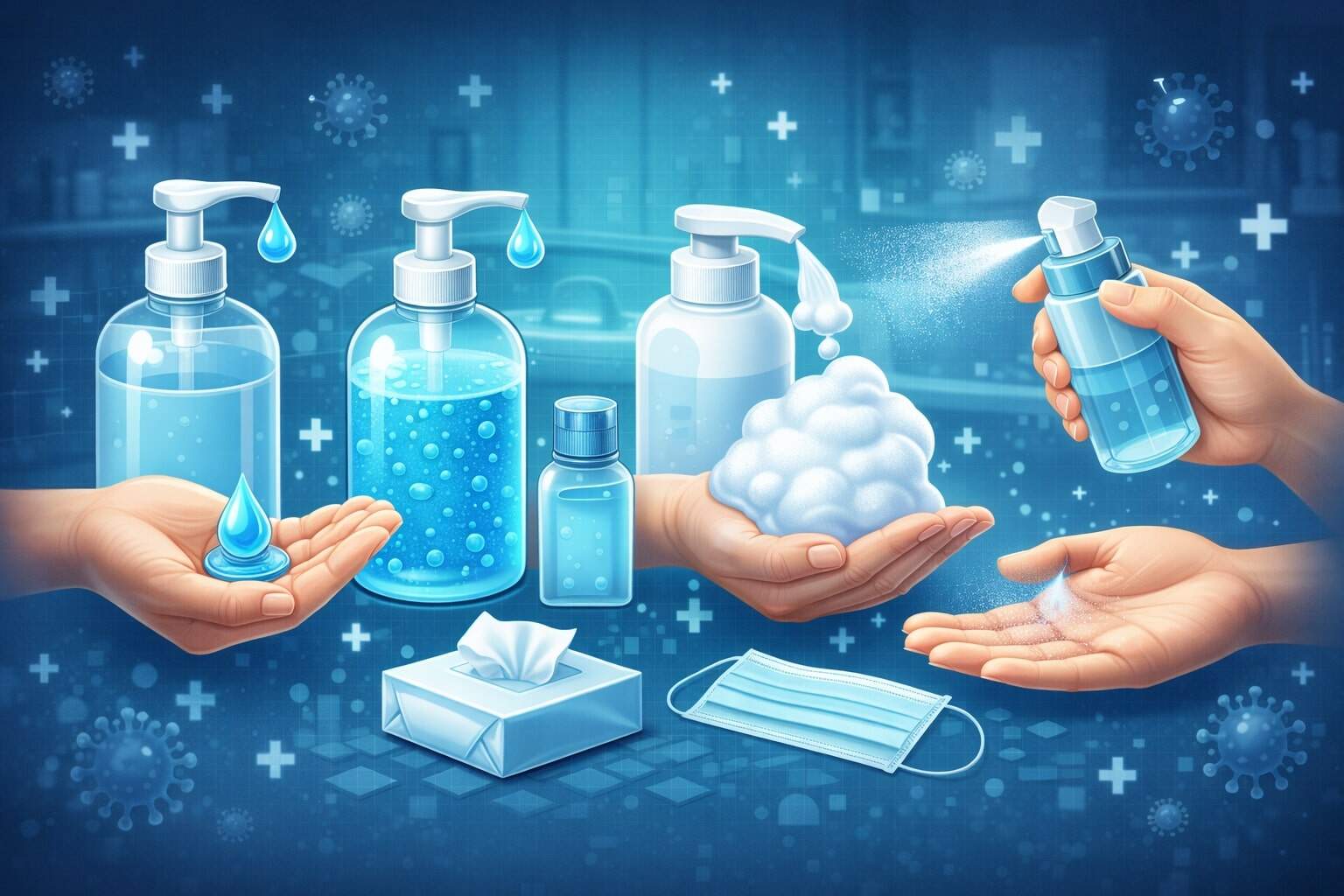
Hand Sanitizer Formats: Gel, Foam, Spray, and Wipes
“Types of hand sanitizer” can also mean types by format. Even when the active ingredient is the same, format affects user experience, coverage, drying time, portability, and compliance. In workplaces, the most common hand sanitizer formats are gel and foam.
In travel, spray and wipes are more common. In some environments, wipes are preferred for quick cleanup of hands and small surfaces—though you should always follow the product label for intended use.
Format choice can influence how consistently people use hand sanitizer. If your team hates sticky gel hand sanitizer, they may skip hand sanitizer entirely. If foam hand sanitizer feels cleaner and dries faster, usage may rise. That makes format selection a practical decision, not just a cosmetic one.
Also, format interacts with dose. Many people under-apply hand sanitizer, especially gel hand sanitizer. Foam dispensers sometimes help by delivering a measured amount. Spray hand sanitizer can lead to uneven coverage if you mist too lightly. Wipes can miss areas like fingertips and thumbs if people do a quick swipe and stop.
A strong strategy is to standardize the active ingredient and then test formats for acceptance. If you’re managing a public-facing location, having a hand sanitizer station that people actually use is more valuable than a perfect hand sanitizer on paper that sits untouched.
Gel vs. Foam Hand Sanitizer: Which Format Works Best?
Gel hand sanitizer is the most recognizable hand sanitizer format. It’s easy to package, easy to carry, and easy to dispense. Many personal-size hand sanitizer bottles are gel hand sanitizer. Gel hand sanitizer also tends to stay put during application, which helps people rub thoroughly instead of flinging product around.
Foam hand sanitizer is common in offices, clinics, gyms, and retail spaces. People often prefer foam hand sanitizer because it spreads quickly and feels less sticky. Foam hand sanitizer can improve compliance in high-traffic environments because users can apply quickly and move on.
The most important point is that gel hand sanitizer and foam hand sanitizer can both work well if the active ingredient is effective and the alcohol percentage is appropriate.
The CDC’s guidance focuses on choosing a hand sanitizer with sufficient alcohol content and using it properly when soap and water aren’t available. In other words, format is secondary to formulation and technique—but format strongly influences whether people will actually use hand sanitizer.
If you’re choosing between gel hand sanitizer and foam hand sanitizer for a workplace, prioritize: (1) user preference, (2) drying time, (3) residue feel, and (4) dispenser reliability. A broken dispenser turns your hand sanitizer policy into a sign on a wall. A reliable hand sanitizer system turns it into a routine.
Spray Hand Sanitizer and Hand Sanitizer Wipes: Portability and Real-World Trade-Offs
Spray hand sanitizer is popular for travel kits and on-the-go use because it can be lightweight, quick, and less messy than gel hand sanitizer. But spray hand sanitizer has a common failure mode: people apply too little.
A light mist may not cover palms, fingertips, and thumbs adequately. The solution is simple—use enough spray hand sanitizer to thoroughly wet hands and rub until dry, just as you would with any hand sanitizer.
Hand sanitizer wipes are convenient for situations where you need friction to remove grime. Wipes also feel more controlled for children or for people who dislike wet gel hand sanitizer. However, hand sanitizer wipes can be limited by surface area.
If the wipe dries out quickly or is too small, coverage suffers. Another practical issue: people may use wipes as a “one swipe and done” method, missing nails and fingertips.
A smart approach is to treat wipes as a convenience format, not as a magic upgrade. If you need true soil removal (grease, dirt), soap and water is often the better choice. But when you need quick hand hygiene without a sink, spray hand sanitizer and wipes can support better habits—if used thoroughly.
Choosing the Right Hand Sanitizer for Your Needs
Choosing the right hand sanitizer is about matching risk level, skin tolerance, environment, and practicality. The “best” hand sanitizer for a hospital lobby is not always the best hand sanitizer for a classroom, and the best hand sanitizer for a delivery driver may not be the best hand sanitizer for an office worker who sits at a desk.
Start with the baseline: if you want the most broadly recommended type, alcohol-based hand sanitizer with at least 60% alcohol is the standard fallback when soap and water aren’t available.
Then refine by constraints: Do you need fragrance-free hand sanitizer? Do you need a hand sanitizer that won’t trigger dermatitis? Do you need a hand sanitizer format compatible with a wall dispenser? Do you need a hand sanitizer that stays usable in a hot car or cold bag?
Also consider behavior. A hand sanitizer only helps if it gets used. In businesses, adoption is improved by thoughtful placement (entrances, counters, break rooms), consistent refills, and choosing a hand sanitizer that employees won’t avoid due to smell or irritation.
Finally, consider use patterns. If you’ll use hand sanitizer occasionally, you can prioritize convenience. If you’ll use hand sanitizer dozens of times a day, you should prioritize skin tolerance, moisturizing strategies, and gentle formulations—without sacrificing alcohol percentage if you’re relying on alcohol-based hand sanitizer.
Best Hand Sanitizer Choices for Workplaces and High-Traffic Public Spaces
In high-traffic spaces—like reception areas, retail counters, fitness centers, and food pickup zones—hand sanitizer selection should focus on fast drying and broad effectiveness. Alcohol-based hand sanitizer is commonly preferred because it aligns with the CDC’s basic recommendation and works quickly when used correctly.
Operationally, foam hand sanitizer in locked dispensers often performs best. It reduces theft, prevents empty bottles from lingering, and makes refilling predictable. If you operate a public space, choose a hand sanitizer that’s easy to source consistently so you’re not switching brands every month. Frequent switching can reduce trust and compliance.
For employee-facing areas, consider offering two options: an alcohol-based hand sanitizer as the default and an alternative hand sanitizer for sensitive skin users, such as a fragrance-free alcohol-based formula with added humectants, or an alcohol-free hand sanitizer option when appropriate.
This improves compliance without forcing everyone into a one-size-fits-all hand sanitizer. Also, place hand sanitizer where hands naturally pause—near doors, next to registers, beside elevators. Placement is a “silent manager” of hand sanitizer habits.
Best Hand Sanitizer Choices for Families, Kids, and Sensitive Skin
In family settings, hand sanitizer decisions include safety, skin health, and supervision. Alcohol-based hand sanitizer remains the most recommended type when soap and water aren’t available, but storage matters because alcohol-based hand sanitizer can be dangerous if swallowed.
The FDA provides consumer guidance on safe hand sanitizer use, reinforcing responsible handling. For sensitive skin, look for hand sanitizer with added moisturizers (like glycerin) and consider fragrance-free options.
Fragrances and essential oils can be a bigger irritation trigger than many people expect, especially with frequent hand sanitizer use. If your child’s hands get dry, it’s not automatically a reason to stop using hand sanitizer; it’s a reason to pair hand sanitizer with a barrier-supporting moisturizer and to choose a gentler hand sanitizer formula.
For kids, a foam hand sanitizer can be easier to dose and less likely to drip. Teach a simple routine: one pump of hand sanitizer, rub palms, backs of hands, between fingers, thumbs, fingertips—keep rubbing until dry. The drying step helps ensure the hand sanitizer has time to work.
When hands are visibly dirty after outdoor play, meals, or craft time, soap and water is often the better option. In a family plan, hand sanitizer is a helpful bridge—not the only tool.
Hand Sanitizer Safety, Labels, and What to Avoid
Hand sanitizer is widely used, but safety issues are real. The most important safety topics include: alcohol percentage, flammability, accidental ingestion, eye exposure, and contaminated or counterfeit products.
The FDA has maintained updates on hand sanitizers consumers should not use, and notes that this specific page is no longer updated, pointing people to recall resources instead. That detail is a reminder: regulatory information evolves, and reputable recall-checking matters.
A crucial concept is that not every product marketed as hand sanitizer meets quality expectations. During high-demand periods, the market has seen contamination concerns (including methanol contamination in some products historically), inconsistent labeling, and misleading claims. Your best defense is choosing hand sanitizer from reputable suppliers and checking labels carefully.
Safety also includes storage. Alcohol-based hand sanitizer is flammable. Avoid storing large quantities near heat sources, and don’t leave big refill containers in high-temperature environments. For businesses, storage protocols are part of responsible hand sanitizer deployment.
If you have frequent hand sanitizer exposure at work—especially in poorly ventilated areas—be mindful of fumes. This doesn’t mean hand sanitizer is unsafe; it means basic ventilation and sensible use are part of best practice.
Reading the Hand Sanitizer Label Like a Pro
A hand sanitizer label is not just branding—it’s a performance and safety document. At minimum, you want to confirm the active ingredient and its percentage.
For alcohol-based hand sanitizer, check that the product contains enough alcohol to meet public health guidance. The CDC recommends at least 60% alcohol for hand sanitizer when soap and water aren’t available.
Look for clear ingredient names: ethanol (ethyl alcohol) or isopropyl alcohol. Avoid vague labels that don’t state a percentage. If the label is confusing, missing basic details, or looks like a poor-quality print, treat that as a red flag—especially when buying hand sanitizer online.
Next, check warnings: flammability, external use only, keep out of reach of children, avoid contact with eyes. Legitimate hand sanitizer labels usually include directions for use, such as applying enough hand sanitizer to cover all hand surfaces and rubbing until dry.
Finally, review claims. Be skeptical of hand sanitizer that promises unrealistic protection like “24-hour germ kill” without clear context. In most daily situations, reliable hand sanitizer plus correct use is what matters, not hype.
Unsafe or Contaminated Hand Sanitizer: Risk Signals and Smart Habits
One of the biggest safety concerns in the hand sanitizer world has been contaminated or improperly manufactured products.
The FDA has issued consumer updates and recall-related guidance, and it explicitly notes that its older “do not use” hand sanitizer update page is no longer updated—meaning consumers should rely on current recall resources.
For everyday buyers, you don’t need to become a chemist. You just need a few smart habits:
- Buy hand sanitizer from reputable retailers or established suppliers.
- Avoid extremely cheap bulk hand sanitizer with unclear labeling.
- Avoid hand sanitizer with strong unusual odors (beyond typical alcohol smell) or separated texture.
- Don’t decant hand sanitizer into unmarked bottles that could be confused with food or beverages.
- If you’re managing a workplace, keep lot/batch info when possible for traceability.
If you suspect a product is unsafe, stop using that hand sanitizer and check recall information through official channels. In a business setting, treat hand sanitizer procurement like any safety-relevant supply chain decision: consistent sourcing beats “whatever is cheapest this week.”
How to Use Hand Sanitizer Correctly (and When Not to)
Correct technique turns hand sanitizer from a “nice idea” into an actual protective habit. Incorrect technique—too little product, missed areas, wiping off early—turns hand sanitizer into theater. The goal is simple: apply enough hand sanitizer, cover all surfaces, and rub until dry.
Public health guidance emphasizes using alcohol-based hand sanitizer with sufficient alcohol concentration when soap and water aren’t available. But even the right hand sanitizer won’t perform well if you use it poorly.
Knowing when not to use hand sanitizer is also important. When hands are visibly dirty or greasy, or after certain bathroom-related situations, washing with soap and water is typically preferred. A good routine is flexible: use hand sanitizer when it fits, wash when washing is clearly better.
Also, avoid common mistakes: applying hand sanitizer to wet hands (it can dilute), using hand sanitizer on heavily soiled hands, and using hand sanitizer as a substitute for cleaning surfaces that need disinfecting (unless the product is labeled for surfaces).
Step-by-Step Hand Sanitizer Technique That Actually Works
Here’s a reliable hand sanitizer technique you can teach to employees, family members, or students:
- Dispense enough hand sanitizer to fully cover both hands.
- Rub palm to palm with hand sanitizer.
- Rub the back of each hand with the opposite palm.
- Interlace fingers and rub between them with hand sanitizer.
- Rub thumbs thoroughly (thumbs are commonly missed).
- Rub fingertips and nail beds against the opposite palm.
- Keep rubbing hand sanitizer until hands are completely dry.
The “until dry” part is essential. Drying time supports contact time. If you stop early, you cut short the period where hand sanitizer can act on microbes.
In workplace training, you’ll get better results by keeping instructions simple and repeating them visually near hand sanitizer stations. Posters help. So does choosing a hand sanitizer that dries quickly and doesn’t leave residue.
Finally, remember that the CDC’s guidance is clear about the baseline: if soap and water are unavailable, use a hand sanitizer with at least 60% alcohol. This guidance pairs best with correct technique.
When Soap and Water Beats Hand Sanitizer
Hand sanitizer is convenient, but it’s not always the best choice. Soap and water is especially important when hands are visibly dirty, greasy, or contaminated with certain materials. Think: after handling raw food, after yard work, after changing diapers, after fixing equipment, or after dealing with body fluids.
Soap and water also physically remove dirt and organic material, which can improve overall cleanliness. Hand sanitizer works on microbes but doesn’t “lift away” grime the way washing does.
If you’re in food service, childcare, healthcare, or cleaning roles, knowing when to wash instead of relying on hand sanitizer is a critical skill.
A practical rule is: if you can see it or feel it (dirt, grease, stickiness), wash. If you can’t wash but need a quick clean after routine contact, use hand sanitizer. The best hygiene system is not “always hand sanitizer” or “never hand sanitizer.” It’s choosing the right tool at the right time and using that tool correctly.
Skin Health and Hand Sanitizer: Preventing Dryness and Irritation
Frequent hand sanitizer use can lead to dryness, irritation, and cracking—especially in cold weather, low-humidity indoor environments, or jobs requiring repeated hygiene.
This is one of the main reasons people stop using hand sanitizer consistently. And inconsistency is a hidden problem: the “best” hand sanitizer doesn’t help if it sits unused because it hurts to apply.
Alcohol-based hand sanitizer is more likely to cause dryness because alcohol can strip oils from the skin. But dryness doesn’t have to be the end of the story.
Many modern hand sanitizer formulas include humectants (like glycerin) to reduce irritation. The WHO formulation guide includes glycerol specifically as a skin-protective component in its recommended alcohol-based handrub formulations.
Skin strategy matters just as much as hand sanitizer choice. If you use hand sanitizer frequently, you should adopt a “sanitize + moisturize” habit.
Use hand sanitizer when needed, allow it to dry, then apply a fragrance-free moisturizer when practical (like after work, before bed, or during breaks). This supports the skin barrier and makes ongoing hand sanitizer use easier.
Hand Sanitizer and Contact Dermatitis: Causes and Prevention
Contact dermatitis from hand sanitizer can come from multiple sources: alcohol itself, fragrances, essential oils, preservatives, or repetitive exposure.
Many people assume alcohol is the only culprit, but fragrance is a frequent irritant. If your hands sting after hand sanitizer, switching to a fragrance-free hand sanitizer can make a big difference.
Also consider your full routine. If you sanitize constantly, wash with harsh soap, and skip moisturizer, irritation becomes more likely. Gloves can also trap moisture and irritants underneath, creating another dermatitis risk in some jobs.
Prevention steps that work in real life include:
- Choose a gentle hand sanitizer (often fragrance-free).
- Use lukewarm water and mild soap when washing.
- Moisturize regularly—especially after shifts and before bed.
- Avoid “hot water scrubbing” cycles that strip skin oils.
- In workplaces, provide lotion near hand sanitizer stations (this improves compliance).
If dermatitis is severe or persistent, consult a clinician. The goal is to maintain skin integrity because healthy skin is a barrier that supports hygiene overall.
Moisturizers, Humectants, and the “Best Pairing” With Hand Sanitizer
If you use hand sanitizer many times per day, moisturizer is not optional—it’s maintenance. The best pairing is a fragrance-free moisturizer that absorbs quickly and doesn’t leave residue. In professional settings, a non-greasy moisturizer is more likely to be used because it doesn’t interfere with tasks.
Look for ingredients such as glycerin (a humectant), ceramides (barrier support), and occlusives like petrolatum for nighttime repair. The WHO’s handrub formulations include glycerol as a component, reinforcing the role of humectants in hand sanitizer systems.
A simple routine is:
- Use hand sanitizer as needed during the day.
- Wash with soap and water when necessary.
- Moisturize at predictable times (after meals, after shifts, before sleep).
For businesses, offering moisturizer alongside hand sanitizer can be a smart health-and-productivity decision. Less skin cracking can mean fewer sick days, fewer complaints, and better compliance with hygiene practices. In other words, moisturizer supports the effectiveness of your hand sanitizer program by making it sustainable.
The Future of Hand Sanitizer: Trends, Innovation, and Predictions
Hand sanitizer has moved from “emergency product” to a long-term part of public-space design. The future of hand sanitizer will likely be shaped by three forces: user experience, safety/quality expectations, and operational efficiency.
First, user experience is becoming a priority. Expect more hand sanitizer formulations that focus on skin comfort—better humectant blends, fewer irritants, and improved feel without sacrificing performance. That means more workplace buyers will demand hand sanitizer that people don’t hate using.
Second, safety and quality monitoring will remain important. The FDA’s shift away from maintaining a single continuously updated “do not use” page (instead directing users to recall resources) reflects how product oversight and communication evolve over time.
As consumers become more aware of counterfeit and low-quality hand sanitizer risks, brands and facility managers will emphasize traceable sourcing and consistent labeling.
Third, operational innovation is accelerating. Touchless dispensers, smart refill monitoring, and usage analytics are increasingly common in larger facilities.
These systems reduce waste, improve availability, and help facilities confirm that hand sanitizer is accessible where it should be. In customer-facing businesses, visible hand sanitizer access can also be a trust signal—part of brand hygiene.
Finally, sustainability pressures will shape packaging. Expect more refillable hand sanitizer systems, concentrated refills, and packaging designed to reduce plastic while maintaining safety and stability. The hand sanitizer category is likely to keep evolving—not as a short-lived trend, but as a permanent hygiene layer in modern life.
FAQs
Q.1: Which type of hand sanitizer is best for everyday use?
Answer: For everyday use, alcohol-based hand sanitizer is usually the most widely recommended choice when soap and water are not available. The CDC recommends using a hand sanitizer with at least 60% alcohol.
This recommendation is practical because alcohol-based hand sanitizer tends to have broad effectiveness and quick action.
That said, “best” also includes what you’ll actually use consistently. If you avoid hand sanitizer because it irritates your skin, you may benefit from switching to a gentler alcohol-based hand sanitizer (fragrance-free, with humectants) and adding a moisturizer routine.
Some people may also choose alcohol-free hand sanitizer in low-risk settings for comfort reasons, but the most common public guidance still points to alcohol-based hand sanitizer as the default option.
A strong everyday approach is: keep a reliable alcohol-based hand sanitizer in your bag or car, use it after routine public contact, and wash hands with soap and water when you get home or when hands are visibly dirty.
Q.2: Is alcohol-free hand sanitizer as effective as alcohol-based hand sanitizer?
Answer: Alcohol-free hand sanitizer can work, but it isn’t always interchangeable with alcohol-based hand sanitizer across all situations. Alcohol-free hand sanitizer typically uses benzalkonium chloride, and its real-world effectiveness depends on the organism and the specific formula.
Research comparing benzalkonium chloride hand sanitizer to alcohol-based hand sanitizer shows that outcomes can vary by testing conditions and targets.
If you’re choosing for general public use, alcohol-based hand sanitizer with sufficient alcohol content is usually the safer default, especially when you need broad coverage.
Alcohol-free hand sanitizer may be useful for users who cannot tolerate alcohol-based hand sanitizer due to skin irritation, but it should still be used correctly and not treated as a perfect substitute for every scenario.
The practical answer: alcohol-free hand sanitizer can be part of your toolkit, but alcohol-based hand sanitizer remains the go-to recommendation in many common guidance sources.
Q.3: What alcohol percentage should a hand sanitizer have?
Answer: A hand sanitizer should contain enough alcohol to be effective. The CDC recommends using a hand sanitizer with at least 60% alcohol when soap and water are unavailable. The FDA’s consumer guidance also references this baseline recommendation and emphasizes safe use.
When shopping, check the label for the alcohol percentage and the type of alcohol (ethanol or isopropyl alcohol). Avoid products that don’t clearly state the percentage. For workplaces, standardize on a hand sanitizer product that is consistently labeled and reliably sourced so you aren’t guessing about effectiveness.
Also remember that alcohol percentage alone isn’t everything—technique matters. You can have the right hand sanitizer and still get poor results if you apply too little or wipe it off before it dries.
Q.4: Can I make my own hand sanitizer at home?
Answer: It’s generally better to buy a properly manufactured hand sanitizer than to make DIY hand sanitizer at home. While WHO-recommended formulations exist and explain what effective alcohol-based hand sanitizer composition looks like, the WHO guidance also includes safety and production considerations, and it’s not the same as casual kitchen mixing.
DIY hand sanitizer often fails in two ways: incorrect final alcohol concentration (too low to work) and poor quality control (contamination, wrong ingredients, unsafe storage). Alcohol-based hand sanitizer is flammable, and producing or storing large amounts can increase risk.
If you’re in a setting considering local production (such as an institution facing supply shortages), follow formal guidance and safety protocols rather than informal recipes. For consumers, the safer approach is choosing reputable hand sanitizer products with clear labeling and an appropriate alcohol percentage.
Q.5: Why does hand sanitizer sometimes sting or burn?
Answer: Hand sanitizer stinging usually happens when the skin barrier is damaged—small cracks, dryness, or dermatitis make alcohol-based hand sanitizer feel sharp. Fragrances and certain additives can also trigger burning sensations, even if the hand sanitizer has a normal alcohol percentage.
To reduce stinging:
- Switch to a fragrance-free hand sanitizer.
- Use moisturizer regularly to repair the skin barrier.
- Avoid harsh soaps and very hot water.
- If hands are visibly dirty, wash gently and moisturize afterward.
Stinging is often a sign you need skin support, not a sign you should abandon hand sanitizer altogether. A sustainable routine combines proper hand sanitizer use with barrier repair.
Conclusion
Hand sanitizer is a powerful, practical tool—when you choose the right type of hand sanitizer and use it the right way. Alcohol-based hand sanitizer remains the most common and widely recommended option for moments when soap and water aren’t available, with guidance emphasizing at least 60% alcohol.
Alcohol-free hand sanitizer, often made with benzalkonium chloride, can be useful in specific situations, especially for users who struggle with dryness, but it isn’t always a perfect substitute for alcohol-based hand sanitizer in every context.
Beyond ingredients, format matters. Gel hand sanitizer, foam hand sanitizer, spray hand sanitizer, and hand sanitizer wipes each have advantages and real-world trade-offs. The best hand sanitizer strategy balances effectiveness, user comfort, and habit formation.
That means using enough hand sanitizer to cover all hand surfaces, rubbing until dry, and switching to soap and water when hands are visibly dirty or when washing is clearly the better choice.
Looking ahead, hand sanitizer is likely to become even more integrated into daily life through touchless dispensers, smarter inventory systems, better skin-friendly formulas, and stronger expectations around product quality and transparency.
The future of hand sanitizer won’t be about panic buying—it will be about sustainable hygiene routines that are easy, safe, and consistent.